Why Desk Workers Need to Think Differently About Movement
Most Americans who work desk jobs understand that sitting all day isn't ideal - but the actual research on how harmful it can be is worth understanding. Studies published in journals such as the Annals of Internal Medicine have found that prolonged uninterrupted sitting is associated with increased risks of cardiovascular disease, type 2 diabetes, and all-cause mortality, even among people who otherwise meet physical activity guidelines. In other words, an hour at the gym doesn't fully cancel out eight hours of unbroken sitting.
The good news is that breaking up sedentary time - even with brief, low-intensity movement - appears to help. Researchers have found that short bouts of light activity dispersed throughout the day can improve blood sugar regulation, reduce fatigue, and support musculoskeletal comfort. The goal isn't to turn your office into a gym. It's to weave more movement into the day you already have.
If you're also thinking about your broader wellness environment, setting up your workspace to support well-being is a practical complement to the movement strategies below.
Set a movement reminder every 45-60 minutes
The simplest intervention is also one of the most evidence-supported: stand up and move briefly, at regular intervals. Research suggests that interrupting sitting every 30 to 60 minutes - even for just a few minutes of light activity - can reduce the metabolic and cardiovascular effects of prolonged sedentary time.
Use your phone's built-in alarm, a calendar block, or a dedicated app to prompt you. The reminder doesn't need to be elaborate - standing, pacing, or doing a short stretch counts. What matters is that you actually interrupt the seated posture consistently throughout the day.
Interrupting sitting every hour - even briefly - is one of the most impactful things a desk worker can do.
Walk during phone calls and virtual meetings
Calls that don't require you to view a screen are an untapped opportunity for movement. Instead of sitting through a phone call or audio-only meeting, stand up and walk - around your home, your floor, or outside if possible.
Many professionals find this habit requires almost no discipline once established: the call itself becomes the cue. Over a typical workweek, this alone can add several thousand steps without carving out dedicated exercise time. It's a low-friction entry point for people who feel too busy to prioritize fitness.
Turning audio calls into walking time can add thousands of steps to your week with minimal effort.
Use a standing desk - but transition gradually
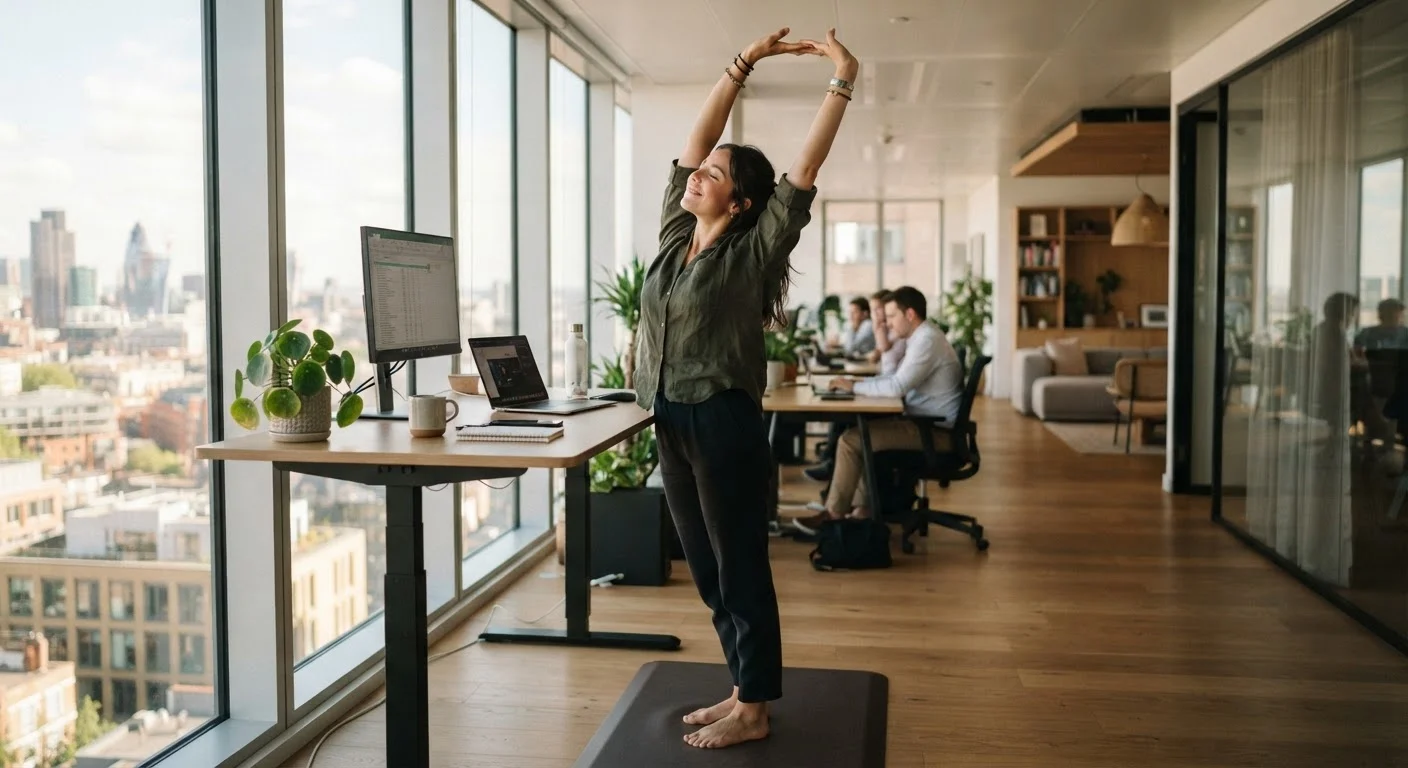
Height-adjustable desks allow you to alternate between sitting and standing throughout the day. Research indicates that standing desks can reduce sitting time, and some studies suggest benefits for lower back discomfort and energy levels - though evidence on long-term outcomes is still developing.
One caution: standing all day is not the goal and carries its own risks, including leg fatigue and varicose vein development. Occupational health guidance generally recommends alternating positions - roughly sitting for 20-30 minutes, standing for 8-10 minutes, and moving for 2 minutes - rather than simply replacing one static posture with another.
Standing desks help most when used to alternate postures, not as a replacement for all sitting.
Try desk-friendly stretches and mobility exercises
Certain muscles become chronically shortened or strained through prolonged sitting: the hip flexors, chest, and upper trapezius are common culprits. Simple stretches - such as a seated figure-four hip stretch, a chest-opener with hands clasped behind the back, or neck rolls - can be done in under two minutes without leaving your workspace.
Mobility work doesn't replace aerobic activity, but it helps manage the postural consequences of desk work and can reduce discomfort that might otherwise discourage movement. Over time, improved flexibility and joint range of motion support a wider variety of physical activity.
Two-minute desk stretches targeting hip flexors and the upper back can offset common postural strain from sitting.
Walk or bike part of your commute when possible
For workers who commute to an office, the journey itself is a movement opportunity. Parking farther away, getting off public transit one stop early, or replacing a short car trip with a walk or bike ride can meaningfully increase daily physical activity without requiring a separate exercise block.
Even modest increases in active commuting have been associated with lower risks of cardiovascular disease and improved mood in observational research. The key is identifying which part of your commute can realistically accommodate a change - then making that adjustment a consistent default.
Active commuting - even just one stop early - adds structured movement without needing extra time in your day.
Take a real lunch break that involves moving
Many desk workers eat at their desk and return immediately to work - effectively doubling down on sedentary time at the midpoint of their day. A 10-15 minute walk after lunch is not only a movement opportunity; research suggests post-meal walking may help moderate blood sugar responses after eating.
Treating the lunch break as a genuine rest-and-move window also supports afternoon cognitive performance. If walking solo feels unmotivating, a regular walking route with a colleague can build the social accountability that makes habits stick. Even short walks deliver meaningful health benefits when done consistently.
A short post-lunch walk supports both blood sugar regulation and afternoon focus.
Making It Stick: Turning Strategies Into Habits
Knowing what to do is only part of the equation - the harder challenge is consistency. Movement habits are most durable when they're tied to existing routines (a concept behavioral scientists call habit stacking), triggered by environmental cues, or made socially reinforcing through a colleague or walking partner.
Habit stacking makes movement automatic
Link a new movement habit to something you already do reliably - brewing coffee, finishing a meeting, or sending a daily report. This 'habit stacking' technique, drawn from behavioral research, reduces the decision-making burden that causes most new habits to fail. Start with one anchor habit before adding more.
If walking appeals to you as a movement baseline, it's worth knowing just how effective it can be. Walking is one of the most underestimated forms of exercise, and even modest daily step increases are linked to measurable health benefits. Movement doesn't need to be intense to be worthwhile - regularity matters more than intensity for most desk workers building a new habit.
It can also help to approach your movement plan as part of a broader daily structure. A well-designed daily routine supports mental health as much as physical health - and the two are closely connected.
This article is for general informational purposes only and does not constitute medical advice. If you have any underlying health conditions or physical limitations, consult a qualified healthcare professional before making changes to your activity levels.