The Core Difference: What Triggered the Damage?
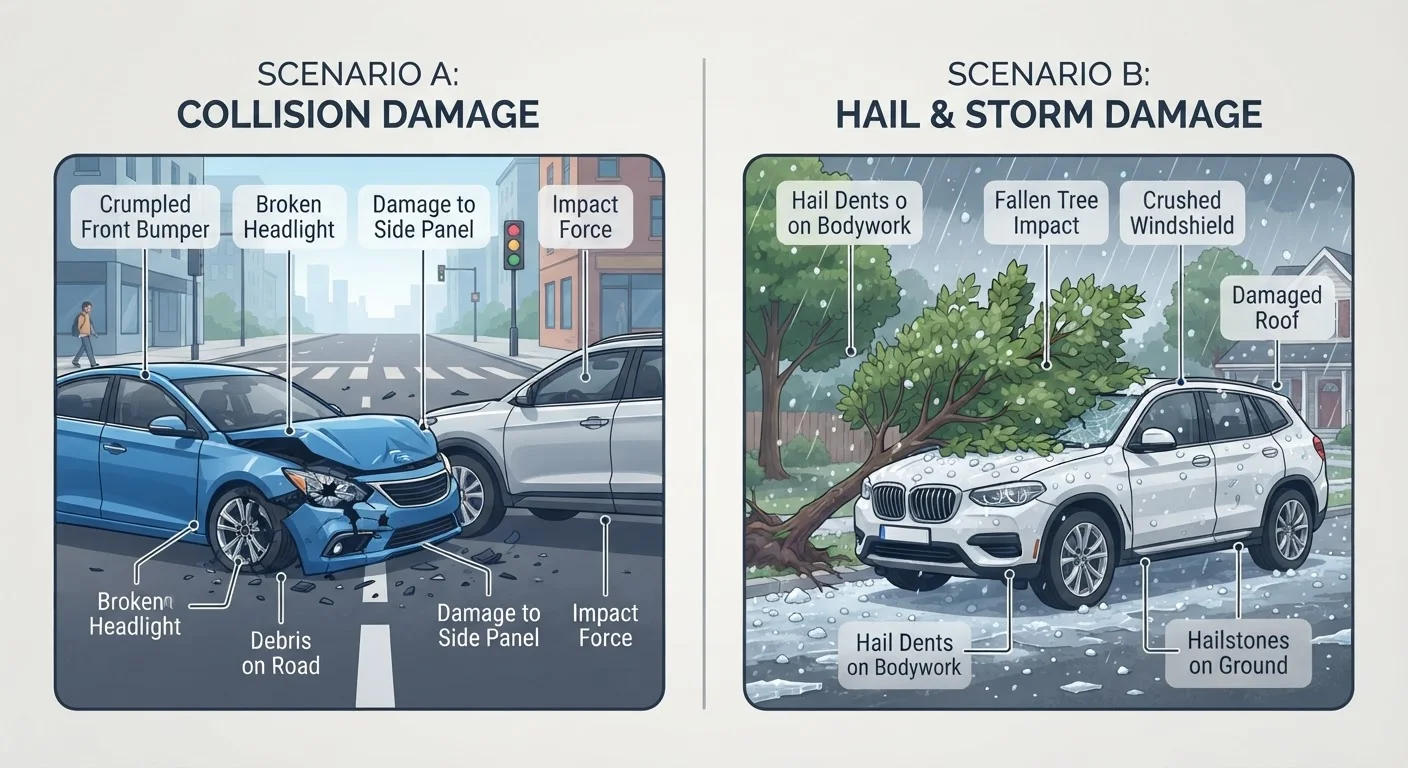
The simplest way to tell collision and comprehensive apart is to ask one question: was the damage caused by your vehicle moving and striking something?
If yes — you backed into a pole, sideswiped a parked car, or slid off an icy road — that's a collision claim. If the damage happened some other way — a hailstorm dented your hood, a thief broke your window, or a deer ran into your door — that's a comprehensive claim.
Insurers sometimes call comprehensive "other than collision" coverage, which is actually a useful label. It covers the losses that don't fit the collision definition. Understanding what qualifies as a covered peril is the foundation for reading either coverage correctly.
| Criterion | Collision Coverage | Comprehensive Coverage |
|---|---|---|
| Primary trigger | Vehicle strikes or is struck by an object | Non-collision event (theft, weather, animals) |
| Common examples | Car accidents, hitting a guardrail | Hail damage, deer strike, theft |
| Fault required? | No — covers regardless of fault | No — covers regardless of fault |
| Covers other vehicle? | No | No |
| Deductible applies? | Yes | Yes |
| Required by lenders? | Typically yes | Typically yes |
| Optional for owned vehicles? | Yes | Yes |
What Collision Coverage Handles
Collision coverage pays to repair or replace your vehicle when it's damaged in a crash — regardless of who caused it. Common scenarios include:
- Hitting another vehicle, whether you're at fault or not
- Running into a fence, guardrail, or building
- Rolling into a ditch or flipping the vehicle
- Being struck by a hit-and-run driver (in many cases)
One thing collision does not cover: damage to the other driver's car. That falls under liability insurance, which is a separate part of your policy. For a full picture of how the pieces fit together, see what each auto coverage type pays for.
After a collision, knowing your next steps matters just as much as having the right coverage. What to do immediately after a minor car accident walks through the process clearly.
~6M
Reported vehicle crashes annually in the US
The National Highway Traffic Safety Administration tracks millions of police-reported crashes each year, underscoring how commonly collision coverage becomes relevant.
~1M
Vehicles stolen annually in the US
FBI Uniform Crime Reports have consistently documented roughly one million vehicle thefts per year, a core risk that comprehensive coverage addresses.
1.5M+
Annual deer-vehicle collisions estimated
State Farm's annual deer-collision report estimates over 1.5 million deer-vehicle incidents per year in the US — nearly all handled as comprehensive claims.
What Comprehensive Coverage Handles
Comprehensive covers a wide range of non-collision losses. Policies vary, but covered events typically include:
- Theft — if your vehicle is stolen or parts are taken
- Weather damage — hail, wind, flooding, and ice
- Fire — including engine fires and wildfires
- Animal strikes — a deer running into your path is a comprehensive claim, not collision
- Falling objects — a tree branch landing on your roof
- Vandalism — keyed paint, smashed windows
Comprehensive is closer to a named perils approach — your policy will list the events it covers. Read those definitions carefully, because flood coverage under a standard auto policy works differently than you might expect. Common coverage misconceptions often center on exactly this kind of gap.
Deductibles, Premiums, and Deciding What Makes Sense
Both collision and comprehensive come with their own deductibles — the amount you pay out of pocket before your insurer covers the rest. Choosing a higher deductible lowers your premium but means you absorb more of the cost when you file a claim.
Understanding how deductibles, premiums, and coverage limits work together helps you make that trade-off deliberately rather than by default.
A few general factors worth considering:
- Your vehicle's actual cash value (ACV): Insurers pay up to the ACV of your car, not its replacement cost. If your car's market value is low, the potential payout may not justify the added premium.
- Your lender's requirements: If you're financing or leasing, you likely have no choice — both coverages are typically required.
- Your local risk profile: Living in an area with high vehicle theft rates or frequent severe weather shifts the value calculation for comprehensive.
If a claim does arise, who handles your claim can also affect your experience and outcome.
This article is for general informational purposes only and does not constitute personalized insurance, financial, or legal advice. Coverage terms, exclusions, and eligibility vary by insurer and state. Always read your policy documents carefully and consult a licensed insurance agent for guidance specific to your situation.