Why the Right Budgeting Method Matters
A budget is only as useful as your ability to follow it. Most Americans understand the value of tracking spending, yet survey data from the National Financial Educators Council consistently shows that a large share of households operate without a formal budget. The gap between knowing you should budget and actually doing it often comes down to choosing a method that fits your real life — not an idealized version of it.
This comparison covers four widely used frameworks: the 50/30/20 rule, zero-based budgeting, Pay Yourself First, and envelope budgeting. For a thorough grounding in budgeting fundamentals alongside these frameworks, see The Complete Guide to Personal Budgeting.
This article is for general informational and educational purposes only and does not constitute personalized financial advice. Consider consulting a licensed financial professional for guidance specific to your situation.
The Four Major Budgeting Frameworks at a Glance
Before diving into each method's trade-offs, here is how the four frameworks compare across the criteria most relevant to everyday consumers.
| 50/30/20 Rule | Zero-Based Budgeting | Pay Yourself First | Envelope Budgeting | |
|---|---|---|---|---|
| Setup time | Minutes | Several hours | Low (automate transfers) | Moderate |
| Ongoing maintenance | Minimal | High — monthly rebuild | Low after automation | Moderate — replenish envelopes |
| Works with irregular income | Moderately — requires adjustment | Yes — rebuilds each period | Yes — vary save amount | Moderately |
| Savings emphasis | Moderate (20% target) | Strong — savings assigned first | Very strong — savings are priority | Weak — spending-focused |
| Spending control | Broad categories only | High — every dollar tracked | Low — spending is unstructured | Very high per category |
| Best suited for | Beginners seeking simplicity | Detail-oriented planners | Savings-focused individuals | Habitual category overspenders |
Each criterion reflects a practical concern: how much time you'll spend, how well the method adapts to irregular income, and how strongly it pushes you toward saving versus simply limiting spending.
50/30/20 Rule: Structure Without Micromanagement
The 50/30/20 rule divides after-tax income into three buckets: 50% for needs (housing, groceries, utilities, insurance), 30% for wants (dining out, entertainment, subscriptions), and 20% for savings and debt repayment. Its appeal is speed — most people can apply it in minutes without tracking every transaction.
The trade-off is imprecision. If your rent alone consumes 45% of take-home pay, the remaining allocations need renegotiation, and the tidy percentages stop being a guide and start being a source of frustration. The method also doesn't distinguish between different types of savings goals or debt payoff strategies. For a deeper look at how this method stacks up against a more tactile approach, see 50/30/20 vs. Envelope Budgeting.
Adapting 50/30/20 to High-Cost Areas
If your housing costs push the 'needs' category well above 50%, consider adjusting the ratios rather than abandoning the method entirely. Some financial educators suggest a 60/20/20 or even 65/15/20 split for high-cost-of-living areas. The underlying principle — balancing needs, wants, and savings — remains sound even when the exact percentages shift.
Zero-Based Budgeting: Accounting for Every Dollar
Zero-based budgeting (ZBB) assigns every dollar of income a specific purpose — expenses, savings, investments, or debt — so that income minus all allocations equals zero. Nothing floats unaccounted for. This approach forces intentionality and often surfaces spending patterns that looser methods miss.
The cost is time. ZBB requires a full accounting of expected income and every anticipated expense before each month begins, then ongoing reconciliation as actual spending unfolds. It rewards people who enjoy or don't mind detailed tracking, and it is particularly powerful for households trying to eliminate debt aggressively. For a step-by-step breakdown, see Zero-Based Budgeting: Giving Every Dollar a Job. Those managing debt alongside their budget may also benefit from pairing ZBB with the strategies covered in debt avalanche vs. debt snowball.
Zero-Based Budgeting With Variable Income
Zero-based budgeting works best when you have a predictable monthly income. If your earnings fluctuate — due to freelance work, tips, commissions, or seasonal employment — building a ZBB around your lowest expected monthly income helps prevent a shortfall mid-month. Avoid budgeting based on best-case income scenarios, as this can create a false sense of financial security.
Pay Yourself First and Envelope Budgeting
Pay Yourself First flips the conventional sequence: instead of saving what remains after spending, you transfer a predetermined amount to savings or investments the moment income arrives, then live on the rest. This method automates the most important financial behavior — saving consistently — and removes the temptation to spend before saving.
Its limitation is that it doesn't actively manage spending categories. If the remainder after saving is handled carelessly, overspending on discretionary items can still lead to cash-flow problems. This method pairs well with the Investing Essentials hub for those ready to direct saved funds into wealth-building vehicles.
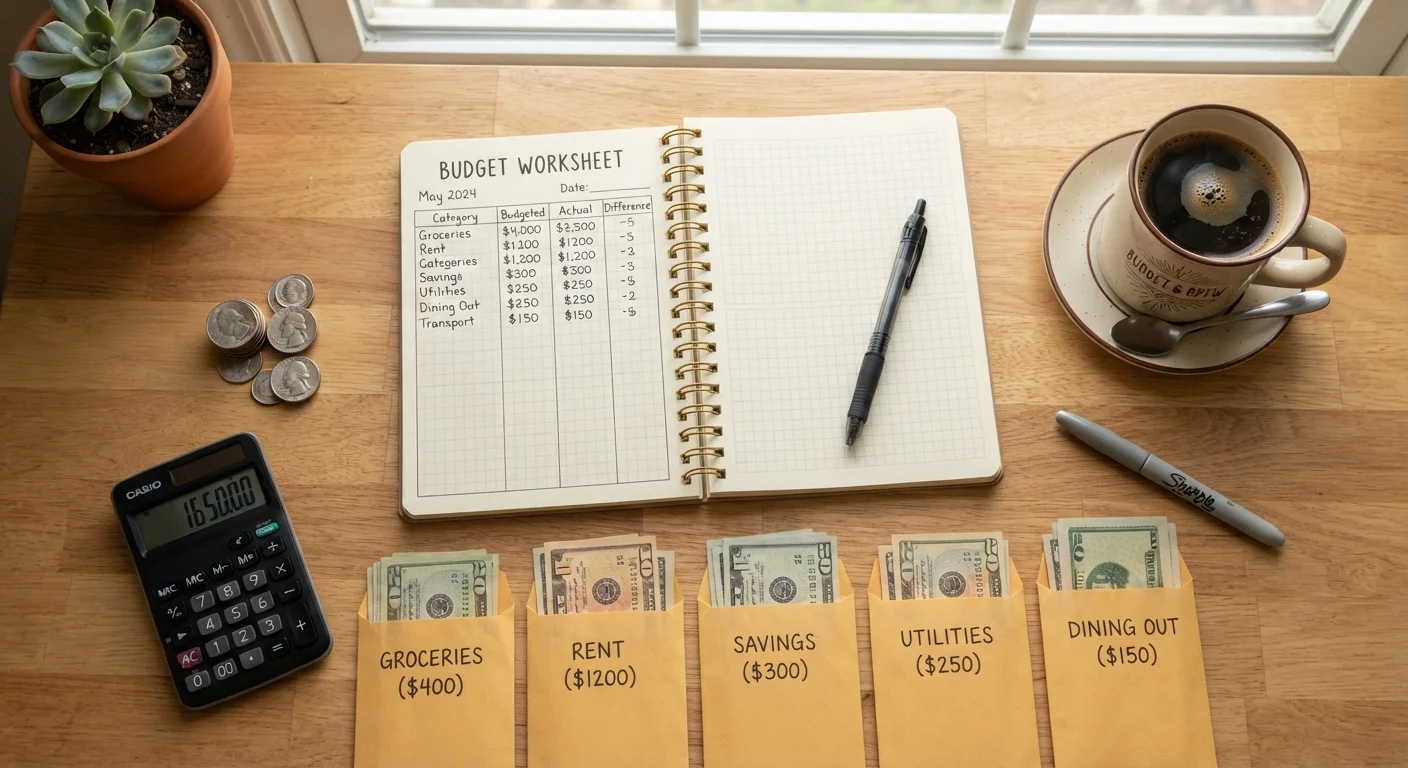
Envelope budgeting allocates physical or digital cash into labeled envelopes for each spending category. When an envelope is empty, spending in that category stops for the month. It is tactile, immediate, and highly effective for people who overspend on specific categories like dining or clothing. The primary drawback is friction — managing physical cash or manual digital equivalents demands consistent effort. For tighter income situations, budgeting on a tight income explores which of these methods holds up under real financial pressure.
~33%
Americans with a detailed monthly budget
Gallup polling has consistently found that roughly one-third of U.S. adults track income and spending in a detailed way each month.
20%
Savings target in the 50/30/20 rule
The 50/30/20 framework, widely referenced in personal finance education, designates 20% of after-tax income toward savings and debt repayment.
Choosing and Adapting Your Approach
The best budgeting method is the one you will actually use consistently. A few honest questions can help narrow the choice: Do you have irregular income? Zero-based budgeting demands more adjustment each cycle but accommodates variability well when done carefully. Do you frequently overspend in one or two categories? Envelope budgeting targets exactly that problem. Are you trying to build long-term wealth? Pay Yourself First locks saving in before discretionary spending can erode it.
Methods can also be combined. Some households use Pay Yourself First to automate saving, then apply 50/30/20 to the remainder, or use envelope budgeting only for categories that historically run over. For help thinking through whether a spreadsheet or an app better supports your chosen method, see Spreadsheet Budgeting vs. Budgeting Apps.
Budgeting is a habit, not a one-time event. Reviewing your method quarterly — and adjusting when life changes — is what converts any framework into lasting financial progress. For broader guidance on savings and debt alongside your budget, the Saving & Debt hub is a useful next step.