What Is a Personal Budget and Why It Matters
A personal budget is a forward-looking plan that maps your expected income against your planned spending over a set period — typically one month. Far from being a tool of deprivation, a budget is what separates intentional spending from financial drift. When you know exactly where your money is going, you can direct it toward what genuinely matters to you.
Research consistently shows that Americans who follow a written budget feel more confident about their finances and are better positioned to handle unexpected expenses. The Federal Reserve's Report on the Economic Well-Being of U.S. Households has repeatedly found that a significant share of adults would struggle to cover a $400 emergency — a vulnerability that thoughtful budgeting directly addresses.
~40%
Adults unable to cover a $400 emergency
According to the Federal Reserve's Report on the Economic Well-Being of U.S. Households, roughly 4 in 10 adults have reported difficulty handling an unexpected $400 expense.
32%
Americans who use a detailed monthly budget
Gallup polling has consistently found that fewer than one-third of American adults maintain a detailed written budget each month.
3–6 months
Recommended emergency fund coverage
Most personal finance experts and consumer financial protection guidance recommend maintaining three to six months of living expenses in an accessible savings account.
If you're entirely new to the concept, our plain-language beginner's guide walks through every foundational term before you build anything.
Core Budgeting Frameworks Explained
No single budgeting method works for everyone. The most widely used frameworks each reflect a different philosophy about how money should flow.
- 50/30/20 Rule: Allocate 50% of after-tax income to needs, 30% to wants, and 20% to savings and debt repayment. It's simple enough for beginners but may not reflect the reality of high-cost-of-living areas where housing alone can exceed 50%.
- Zero-Based Budgeting: Every dollar of income is assigned a job — spending, saving, or debt payment — until the balance reaches zero. This method requires more effort but leaves nothing unaccounted for.
- Pay Yourself First: Savings and investment contributions are automatically transferred at the start of each pay period, and the remainder is spent freely. It enforces saving discipline without requiring granular tracking.
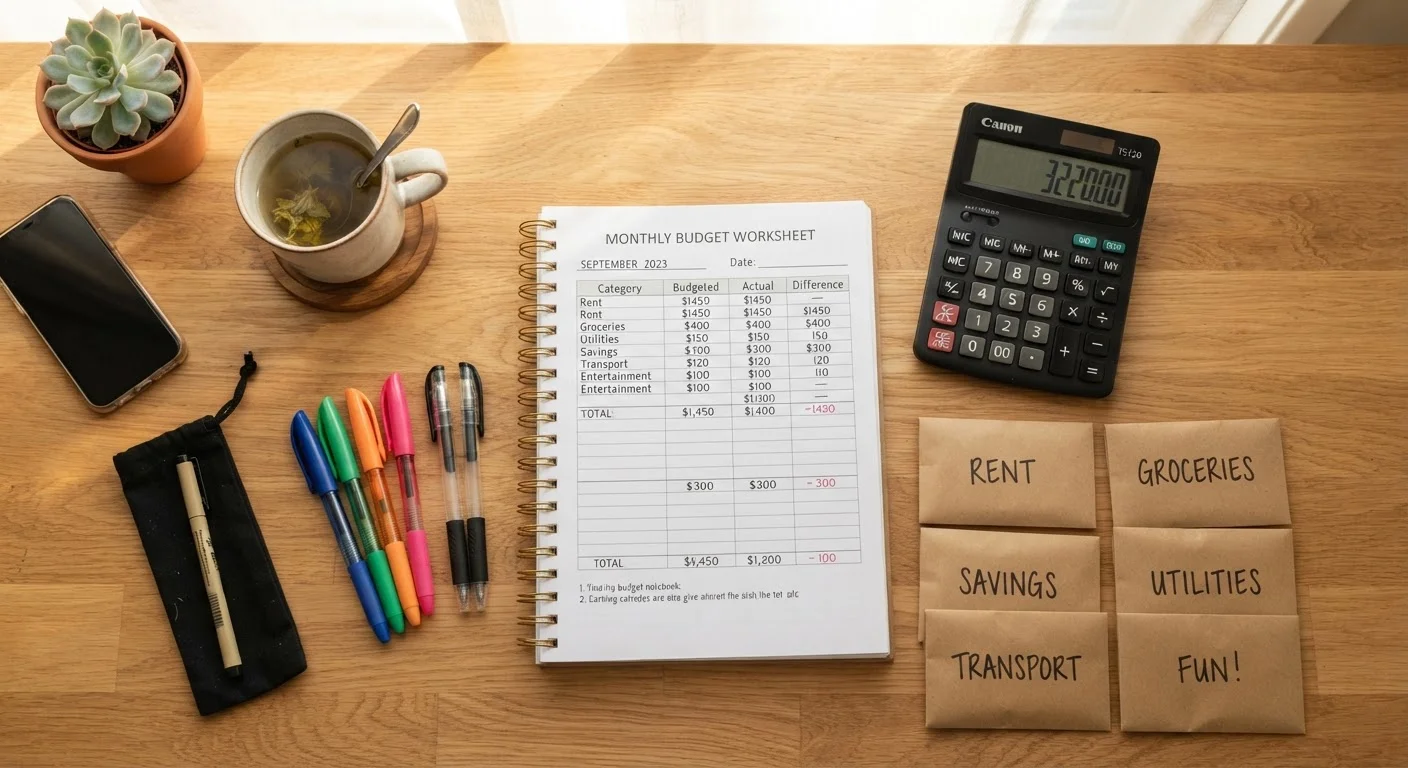
- Envelope System: Cash (or digital equivalents) is divided into category-specific envelopes. When an envelope is empty, spending in that category stops for the month. Especially effective for variable spending categories like dining and entertainment.
For a detailed side-by-side comparison of these approaches, see our budgeting methods comparison guide.
When choosing a budgeting method, prioritize the one that matches your personality over the one that looks most optimal on paper. A simple system you'll follow every month beats a sophisticated system you'll abandon by week three.
Behavioral consistency is the single biggest driver of budgeting success. Complexity is the most common reason people quit their budget entirely.
If you use the 50/30/20 rule and live in a high-cost city, adjust the ratios rather than abandoning the framework entirely — for example, 60/20/20 or 65/15/20 may be more realistic and still enforces the principle of deliberate allocation.
Rigid adherence to textbook ratios in high-cost markets leads to discouragement. The goal is intentional allocation, not hitting a specific percentage.
How to Build Your First Budget Step by Step
Building a budget doesn't require special software or financial expertise. It requires honest numbers and a consistent process.
- Calculate your net income. Start with take-home pay — the amount deposited after taxes, Social Security, and any employer benefit deductions. Include all income sources: wages, freelance earnings, rental income, and regular side income.
- List all fixed expenses. Fixed expenses are the same amount every month: rent or mortgage, car payment, insurance premiums, loan minimums, and subscription services.
- Track your variable expenses. Groceries, gas, dining, clothing, and entertainment fluctuate. Review three months of bank and credit card statements to establish realistic averages rather than guessing.
- Assign a savings target. Before spending discretionary income, decide how much goes to an emergency fund, retirement account, or other savings goal. Treat this as a non-negotiable line item.
- Balance income against outflows. If expenses exceed income, identify discretionary categories where you can reduce spending. If income exceeds expenses, decide deliberately what to do with the surplus.
Our monthly budget setup checklist provides a printable, step-by-step guide to completing this process before each new month begins.
Use Your First Budget as a Diagnostic Tool
Your first month's budget will almost certainly be imperfect — and that's by design. Think of it less as a strict spending plan and more as a data-gathering exercise. The numbers you collect in month one will make month two's budget far more accurate and actionable.
Common Budgeting Pitfalls and How to Avoid Them
Even well-intentioned budgets fail when common traps go unrecognized.
- Forgetting irregular expenses
- Annual costs like car registration, holiday gifts, and insurance renewals don't appear monthly — but they derail budgets that ignore them. Divide annual amounts by 12 and set that money aside each month in a dedicated sinking fund.
- Setting unrealistic spending limits
- A grocery budget of $200 per month for a family of four sets you up for failure and frustration. Ground every target in historical data, not aspiration.
- Not accounting for income variability
- Freelancers and hourly workers should build budgets around their lowest typical monthly income, not their average or best month.
- Treating the first draft as final
- A budget is a living document. Expect to revise spending categories during the first three months as you gather real data.
Don't Ignore Irregular and Annual Expenses
One of the most common reasons budgets fail is that they only account for recurring monthly bills. Car maintenance, medical copays, annual subscriptions, and seasonal expenses can easily add up to several thousand dollars per year. Build a sinking fund — a separate savings category — by setting aside a fixed amount monthly for these predictable-but-irregular costs.
Habits That Support Long-Term Financial Stability
A budget is the foundation, but lasting financial health is built through consistent habits layered on top of it.
- Weekly check-ins: A five-minute review of spending against plan prevents small overages from compounding into large ones.
- Monthly budget resets: Revisit category allocations at the start of each month to account for changes in income, bills, or priorities.
- Automated saving: Automate transfers to savings and retirement accounts on payday so saving happens before any discretionary spending decision is made.
- Linking the budget to goals: Budgets that serve concrete goals — a home down payment, an emergency fund, debt payoff — are far more motivating than abstract frugality.
Budgeting becomes substantially more powerful when combined with a debt reduction strategy and a structured approach to saving. Our complete guide to saving and managing debt covers how to build an emergency fund and reduce debt alongside your budget. When you're ready to put surplus savings to work, explore the Investing Essentials hub for foundational guidance.
A Budget Is a Starting Point, Not a Verdict
If your first budget reveals that you're spending more than you earn, that's valuable information — not a cause for shame. Many Americans carry more financial stress than they realize simply because they've never mapped their cash flow. Awareness is the prerequisite for change, and change is entirely achievable with consistent effort over time.
This article is for general informational and educational purposes only and does not constitute personalised financial advice. Please consult a qualified financial professional for guidance specific to your situation.