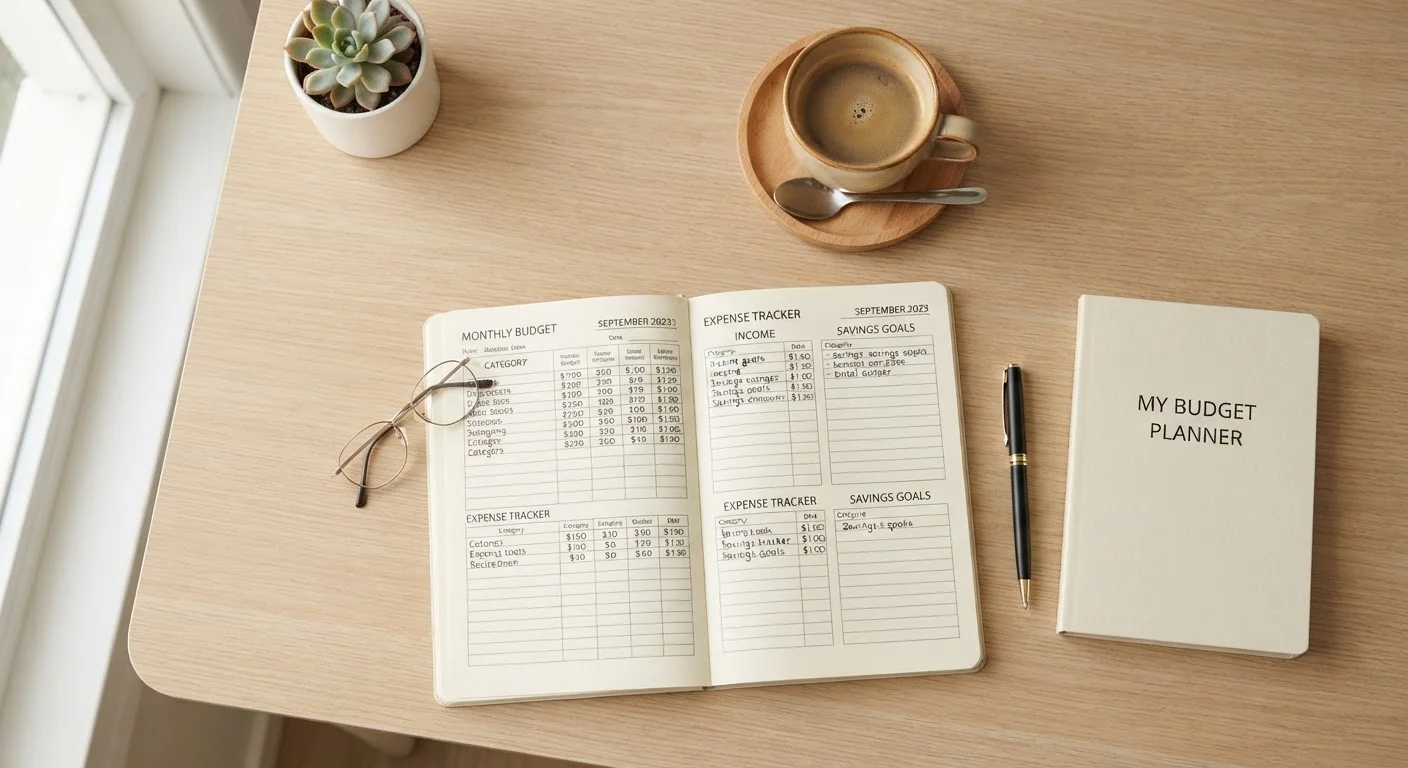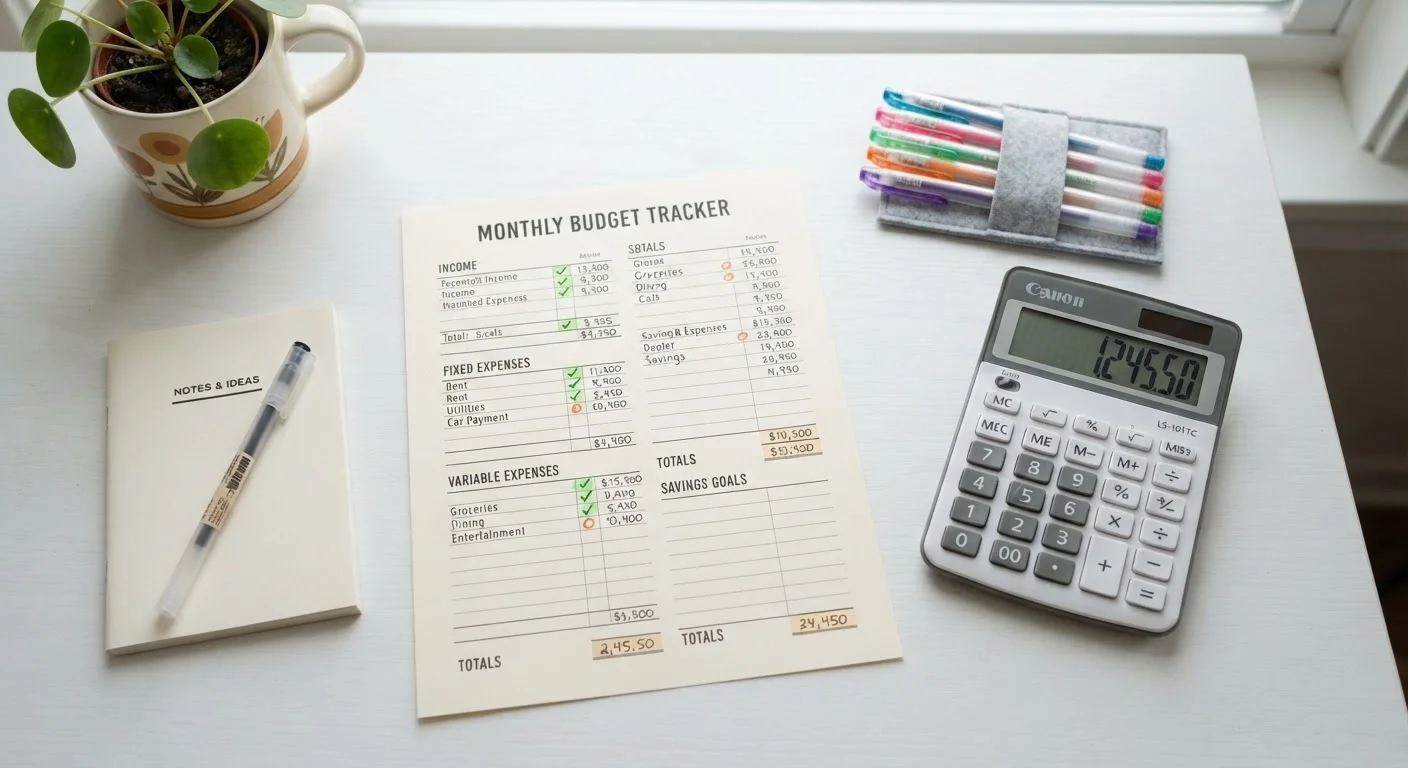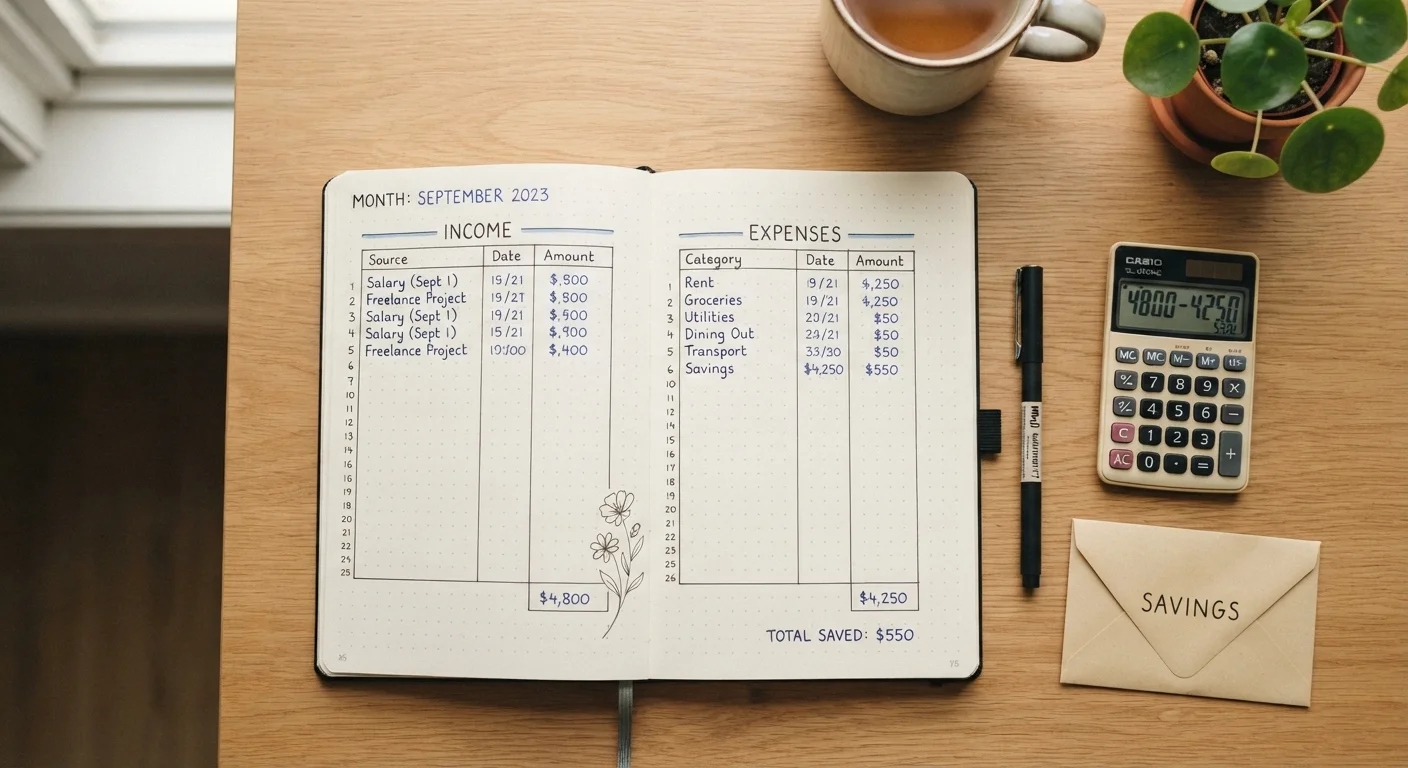

What a Budget Actually Is
A budget is simply a written plan that tells your money where to go before the month begins. It is not a restriction on enjoyment, a spreadsheet only accountants can love, or proof that you are struggling financially. It is a tool — one that works equally well whether you earn $30,000 or $130,000 a year.
At its core, a budget answers one question: Is your spending aligned with what you actually value? Without a plan, most people discover at month's end that their money drifted toward things they barely remember, rather than toward goals they care about.
If you've avoided budgeting because it sounds complicated or joyless, common budgeting myths are worth examining — many of the assumptions that keep people from starting simply don't hold up.
Net Income
The amount of money you actually receive after taxes and pre-tax deductions are taken out — the real number available to budget with.
Fixed Expense
A bill or payment that stays the same amount every month, such as rent or a loan payment, making it easy to plan for in advance.
Variable Expense
A spending category whose amount changes month to month — like groceries or gas — requiring ongoing attention to stay on track.
Sinking Fund
A savings pool you build gradually each month to cover a known future expense, preventing one-time costs from throwing off your budget.
Cash Flow
The movement of money in and out of your finances — positive cash flow means you're bringing in more than you're spending.
Discretionary Spending
Money spent on non-essential wants — dining out, entertainment, hobbies — as opposed to necessary expenses like housing and utilities.
Understanding Your Income and Expenses
Before you can allocate money, you need an accurate picture of how much comes in and where it currently goes. This two-sided view is the raw material of every budget.
Your Income
Use your net income — the amount deposited into your account after taxes and any pre-tax deductions like a 401(k) contribution or health insurance premium. This is the real number you have to work with. If your income varies, calculate a conservative average using the past three to six months of bank statements.
Your Expenses
Expenses fall into two broad categories:
- Fixed expenses — amounts that stay the same each month, such as rent, a car loan payment, or a subscription. These are predictable and easy to plan around.
- Variable expenses — amounts that shift, such as groceries, gas, dining out, and utilities. These require more attention because they're where overspending most often occurs.
A third category worth naming is irregular expenses — costs that don't appear every month but are entirely predictable, like annual insurance premiums, car registration, or holiday gifts. Dividing these annual costs by 12 and setting that amount aside monthly prevents them from derailing your budget when they arrive.
For a full glossary of terms you'll encounter, see essential budgeting vocabulary every American should know.
Choosing a Budgeting Framework
Once you understand your numbers, you need a structure to organize them. Several widely used frameworks exist, and none is universally superior — each has trade-offs depending on your lifestyle, income type, and how much detail you want to manage.
- 50/30/20 Rule — Allocates roughly 50% of net income to needs, 30% to wants, and 20% to savings and debt repayment. Simple and flexible, this is often the best starting point for first-time budgeters.
- Zero-Based Budgeting — Every dollar of income is assigned a specific purpose so that income minus all allocations equals zero. It demands more effort but gives granular control. Learn more in our guide to zero-based budgeting.
- Pay Yourself First — Savings and investments are moved out of your account immediately when income arrives; the rest is available to spend freely. Works well for people who dislike detailed tracking.
A side-by-side look at how these methods compare — including who each suits best — is covered in budgeting methods compared.
Start Simple, Then Add Detail
If no framework feels right immediately, start with just three categories: needs, wants, and savings. You can always refine your system once you've built the habit of tracking. A budget you actually use beats a perfect budget you abandon after two weeks.
Building Your First Budget Step by Step
With a framework chosen, here is a practical sequence for putting your first budget together:
- Gather one to three months of bank and credit card statements. Real data beats estimates every time.
- Calculate your average monthly net income. Include all reliable income sources.
- List every expense and categorize it as fixed, variable, or irregular.
- Apply your chosen framework to set target amounts for each category.
- Compare your targets to your actual spending. Gaps reveal where attention is needed.
- Adjust categories until income minus expenses equals zero (or a positive number directed toward savings or debt).
- Track spending throughout the month — weekly check-ins of 10 to 15 minutes are enough for most people.
Your first budget will be imperfect, and that is expected. Month two will be more accurate because you'll have real data from month one. Building a savings habit alongside your budget compounds the benefit — starting a savings habit from zero walks through how to do that even in small amounts.
Don't Budget From Memory Alone
Most people underestimate their spending by 20% to 30% when relying on recall. Always anchor your categories in real transaction data from bank or credit card statements — at least one full month's worth before you set your first targets.
Common Mistakes and How to Avoid Them
Most early budgeting struggles come from a handful of predictable errors, not from a lack of financial skill.
Forgetting Irregular Expenses
Budgeting only for monthly bills leaves you unprepared when the car registration or dentist bill arrives. Build a category called a sinking fund — a savings pool designated for a known future expense — and contribute to it monthly.
Setting Unrealistic Targets
Slashing your dining-out budget from $400 to $50 overnight almost never sticks. Gradual reductions of 10% to 20% month over month are far more sustainable.
Treating the Budget as a One-Time Event
A budget that isn't reviewed monthly quickly becomes fiction. Life changes — income shifts, new bills appear, old subscriptions are cancelled. A short monthly review keeps the plan grounded in reality.
Skipping the "Why"
Budgets without a motivating goal feel like deprivation. Whether the goal is paying off a credit card, building an emergency fund, or saving for a down payment, naming it gives every category a purpose. For a deeper dive into building lasting financial stability, building financial resilience is a comprehensive next step.
This article is for general informational purposes only and does not constitute personalized financial advice. Consult a qualified financial professional for guidance tailored to your individual circumstances.