Where It All Begins: The Service Entrance
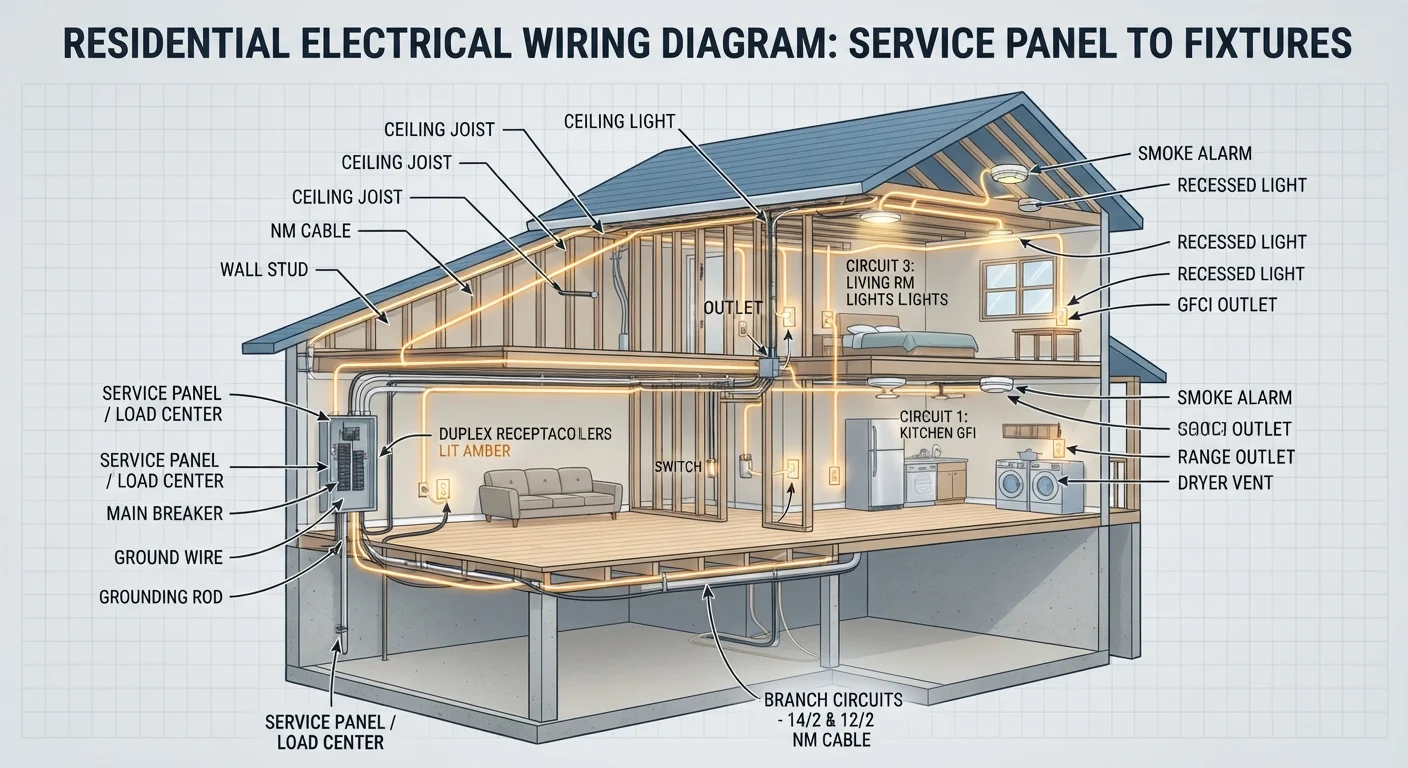
Every home's electrical journey starts at the service entrance - the point where power from the utility company arrives. In most American homes, three wires (two hot lines carrying 120 volts each, plus a neutral) run from a utility pole or underground conduit to a weatherhead or meter base on the outside of your home. The electric meter sits here, measuring your consumption in kilowatt-hours (kWh).
From the meter, power travels to the main electrical panel - your home's distribution center. The main panel houses the main breaker, which controls power to the entire home, as well as individual circuit breakers for each branch circuit. Panel capacity is measured in amps; older homes may have 60- or 100-amp service, while most new construction installs 200-amp panels to handle modern electrical loads.
Locate Your Panel Before You Need It
Find your main electrical panel now - before an emergency. Label each breaker clearly to indicate which area or appliance it controls. A well-labeled panel lets you cut power quickly and safely to any part of your home, and it makes an electrician's job faster and cheaper.
Circuits, Breakers, and How Power Is Distributed
From the panel, electricity flows through branch circuits - individual loops of wiring that each serve a specific area or set of devices. A typical home has dozens of circuits: separate ones for lighting, general-purpose outlets, and dedicated high-draw appliances.
Each circuit is protected by a circuit breaker, a resettable switch that trips when current exceeds the circuit's safe capacity. A 15-amp breaker protects circuits wired with 14-gauge wire; 20-amp breakers pair with 12-gauge wire for heavier loads like kitchen countertop outlets. When a breaker trips repeatedly, it's signaling a real problem - either the circuit is overloaded or there's a fault - not something to bypass or ignore.
Large appliances require dedicated 240-volt circuits fed by double-pole breakers that occupy two slots in the panel. These circuits serve only one device and are not shared with other loads.
~51,000
Home electrical fires per year in the U.S.
According to the U.S. Fire Administration, electrical fires are among the leading causes of residential fires, underscoring the importance of proper wiring and safety devices.
200 amps
Standard service capacity for new construction
Most newly built American homes are wired with 200-amp service panels to accommodate growing electrical loads from appliances, EV chargers, and home offices.
~1/40 sec
GFCI response time to a ground fault
GFCI devices are designed to interrupt current in as little as 1/40th of a second - fast enough to prevent electrocution in most scenarios involving ground faults.
Wiring, Grounding, and Safety Devices
The wires running through your walls are typically bundled in non-metallic sheathed cable (commonly known by the trade name Romex). Each cable contains at least two current-carrying conductors - a black hot wire and a white neutral wire - plus a bare copper ground wire. The ground wire provides a safe path for fault current to travel back to the panel and trip the breaker, rather than through a person or combustible material.
Modern electrical codes require additional protection in high-risk areas:
- GFCI (Ground Fault Circuit Interrupter) protection - required near water sources like bathrooms, kitchens, and outdoor outlets. These devices detect tiny current imbalances and cut power in under a tenth of a second.
- AFCI (Arc Fault Circuit Interrupter) protection - required on most bedroom and living area circuits in newer construction. AFCIs detect dangerous arcing conditions that can ignite fires inside walls.
Homes built before the 1960s may have older wiring types - such as knob-and-tube or ungrounded two-wire systems - that lack these protections. A licensed electrician can evaluate what upgrades may be appropriate.
Aluminum Branch-Circuit Wiring: Know the Risk
Homes built between roughly 1965 and 1973 may contain aluminum branch-circuit wiring, which expands and contracts more than copper and can loosen connections over time, creating fire risk. If your home is from this era, have a licensed electrician inspect the wiring. There are recognized remediation methods, but this is not a DIY assessment.
What Homeowners Can - and Can't - Safely Do
Understanding your electrical system empowers you to troubleshoot minor issues and communicate more effectively with professionals. Resetting a tripped breaker, replacing a damaged outlet cover, or installing a smart thermostat on an existing circuit are generally manageable tasks for a careful homeowner following manufacturer instructions.
However, a wide range of electrical work - adding new circuits, upgrading a panel, moving wiring, or installing new subpanels - requires licensed electricians and, almost always, a permit and inspection. This is not bureaucratic red tape; it is how your local authority verifies the work is safe before walls close up. Unpermitted work can complicate home sales and may affect your homeowner's insurance coverage.
If you are planning a renovation or noticing recurring electrical problems, consider consulting a licensed electrician early. See our guide on hiring a contractor for what to verify before anyone starts work. For broader home improvement context, our introduction to home insulation is another useful foundation piece. And if you are thinking about smart devices that connect to your electrical system, review what data smart home devices collect before plugging in.
This article is for general educational purposes only and does not constitute electrical advice. Always consult a licensed electrician and verify local permit requirements before undertaking any electrical work in your home.