
The Old Saying Has Real Math Behind It
Most people have heard the phrase since childhood, but it turns out the advice maps directly onto one of the most studied principles in modern investing: diversification. Economist Harry Markowitz formalized the idea in the 1950s, demonstrating mathematically that combining assets with different risk profiles can improve a portfolio's overall risk-adjusted performance. The phrase predates the theory by centuries — but the logic is the same.
The core insight is simple: if all your money is in one stock and that company collapses, you lose everything. But if your money is spread across many companies, sectors, and asset types, a single failure becomes a manageable setback rather than a catastrophe. For an accessible grounding in investment vocabulary, see our beginner's glossary of investing terms.
“Diversification is the only free lunch in investing. By spreading risk intelligently, investors can reduce portfolio volatility without necessarily sacrificing expected returns.”
— Harry Markowitz, Nobel Prize-winning economist and pioneer of Modern Portfolio Theory
What Diversification Actually Looks Like
Diversification operates at several levels, and understanding each one helps you apply it meaningfully rather than superficially.
- Asset class diversification: Holding a mix of stocks, bonds, and cash equivalents. These categories historically respond differently to economic conditions. Our article on how stocks, bonds, and cash work together explains the interplay in depth.
- Sector diversification: Within stocks, spreading across industries — technology, healthcare, consumer goods, energy — so that a downturn in one sector doesn't dominate your losses.
- Geographic diversification: Holding some exposure to international markets, since economies around the world don't always rise and fall together.
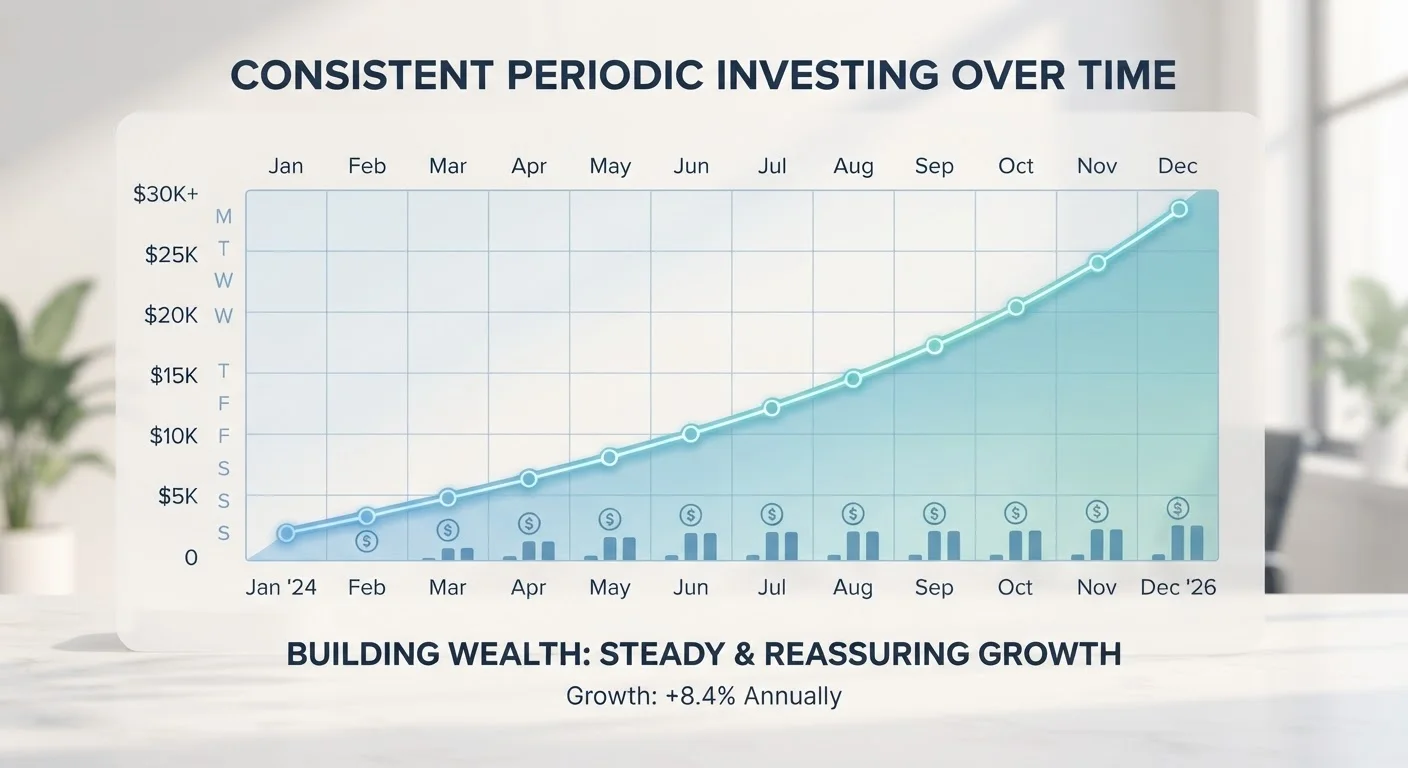
- Time diversification: Investing regularly over time rather than all at once. Dollar-cost averaging is one way to build this habit systematically.
The Risk It Reduces — and the Risk It Doesn't
Diversification is most effective against unsystematic risk — the danger specific to a single company or industry. If a pharmaceutical firm's key drug fails a clinical trial, a diversified investor feels a small ripple; an investor with 80% of their portfolio in that one stock faces a wave.
What diversification cannot do is protect against systematic risk — the broad economic forces that move markets as a whole. A global financial crisis, a sharp rise in interest rates, or a major recession tends to drag down most asset classes simultaneously, even well-diversified portfolios. Understanding both your emotional comfort with risk and your actual financial capacity to absorb losses is equally important — our piece on risk tolerance vs. risk capacity explores that distinction. Historical market data can also provide useful perspective on how portfolios have weathered downturns over time.
Practical Ways Everyday Investors Diversify
You don't need to be a professional portfolio manager to build a diversified investment mix. Several straightforward options exist for ordinary Americans.
Broad index funds track a wide market benchmark — such as the total U.S. stock market or the S&P 500 — giving exposure to hundreds of companies in a single investment. Target-date funds automatically adjust their mix of stocks and bonds based on a target retirement year, becoming more conservative as that date approaches. Both are widely available in workplace retirement plans such as 401(k)s and individual retirement accounts (IRAs).
What these options have in common is built-in diversification that doesn't require constant monitoring or individual stock selection. This matters because many investing myths suggest you need special expertise or large sums to invest wisely — that's generally not true with diversified, low-cost fund options.
This article is for general informational and educational purposes only and does not constitute personalized financial, investment, tax, or legal advice. All investing involves risk, including the possible loss of principal. Consult a qualified, licensed financial adviser before making decisions about your own circumstances.