
Why Market Timing Is So Hard — and Why Most People Shouldn't Try
The idea of buying low and selling high sounds straightforward, but consistently predicting when markets will rise or fall has proven difficult even for professional money managers. Waiting for the "right" moment to invest can mean months or years on the sidelines — and as the math on delayed investing shows, time out of the market carries its own real costs.
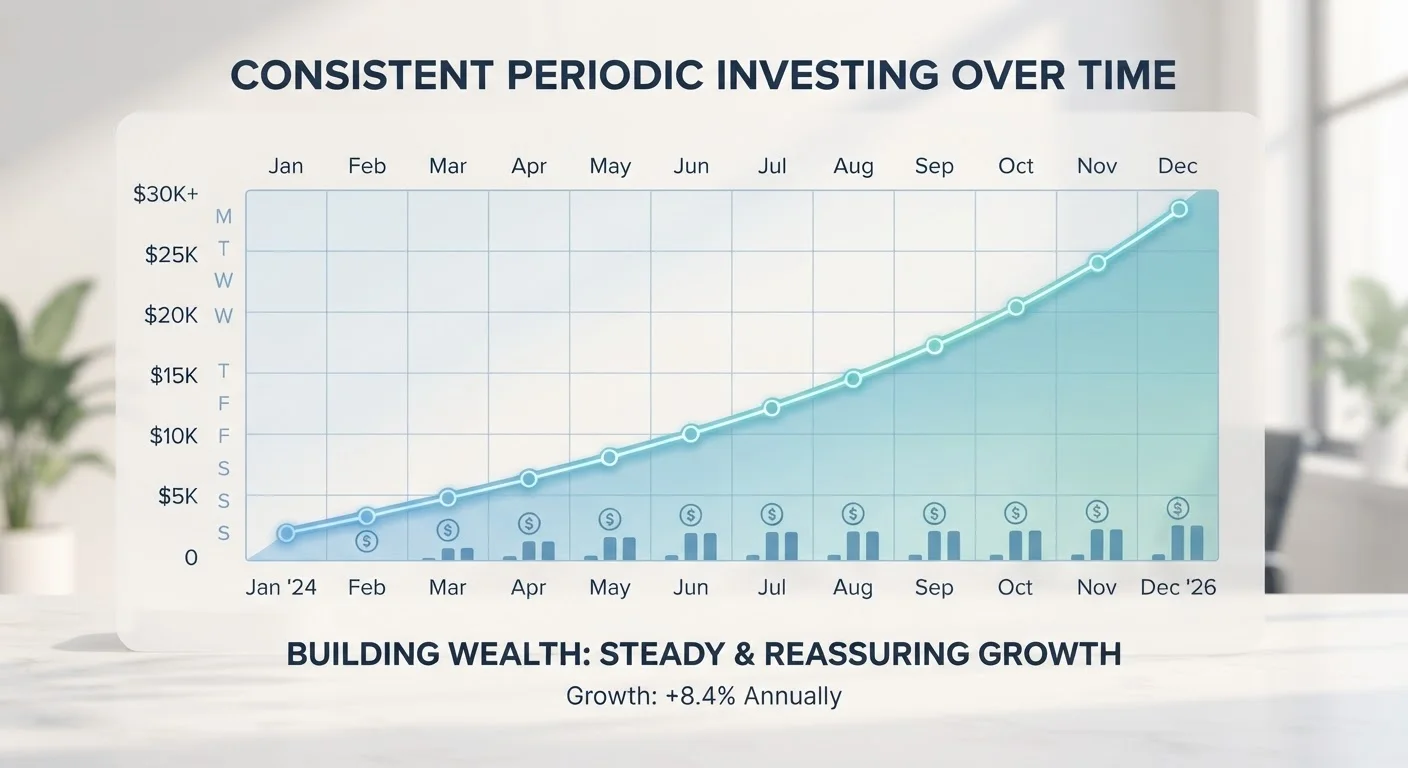
Dollar-cost averaging sidesteps the timing question entirely. Instead of asking "when should I invest?", you simply invest on a fixed schedule. The strategy removes one of the most common psychological barriers to getting started and staying invested through volatile periods.
“The stock market is a device for transferring money from the impatient to the patient.”
— Warren Buffett, Chairman and CEO of Berkshire Hathaway, widely followed long-term investor
How Dollar-Cost Averaging Works in Practice
The mechanics are simple. You decide on a fixed dollar amount — say, $200 — and a regular interval, such as the first of every month. On that date, that amount goes into your chosen investment regardless of the current price.
- When prices fall: Your $200 buys more shares than it did last month.
- When prices rise: Your $200 buys fewer shares, but the ones you already own are worth more.
- Over time: Your average cost per share tends to be lower than if you had tried to buy at specific moments.
Many Americans are already using this strategy without labelling it as such. If your employer deducts contributions from each paycheck and routes them into a 401(k) or similar plan, that is dollar-cost averaging in action. Be sure you understand the key investing terms associated with any account you use.
~57%
U.S. adults who own stock
According to Gallup polling, roughly 57% of American adults reported owning stock in recent years, including through retirement accounts — many of whom invest via payroll deduction, a form of DCA.
66%
Private-sector workers with access to a workplace retirement plan
The U.S. Bureau of Labor Statistics has reported that roughly two-thirds of private-sector workers have access to employer-sponsored retirement plans, most of which operate on a payroll-deduction DCA model.
3 in 10
Americans who say market volatility stops them from investing
Surveys by financial research groups have consistently found that fear of market timing is among the top barriers preventing Americans from starting or increasing investment contributions.
The Behavioral Benefit: Discipline by Design
One underappreciated advantage of DCA is that it builds investing discipline into your routine. When markets drop, the natural instinct is to stop investing or sell — but downturns are precisely when DCA has you buying more shares per dollar. By automating contributions, you remove the temptation to react emotionally to short-term swings.
This matters because several widespread investing myths — such as the belief that you need to pick perfect entry points — keep ordinary people from investing at all. A systematic schedule replaces guesswork with consistency.
Automate to Stay Consistent
Setting up an automatic transfer from your bank account or payroll deduction removes the decision from your monthly routine entirely. Automation is one of the most reliable ways to maintain a DCA habit through both bull and bear markets. Check whether your brokerage or retirement plan offers automatic investment scheduling — most do.
DCA also pairs naturally with diversification principles. Investing regularly into a broadly diversified fund spreads both your timing and your holdings — two layers of risk management working together.
What Dollar-Cost Averaging Cannot Do
Dollar-cost averaging is a disciplined process, not a guarantee. It does not prevent losses if the market declines over the long term. It does not ensure you will earn a positive return. And in a consistently rising market, investing available funds all at once has historically outperformed DCA because every dollar starts compounding sooner.
The strategy is most appropriate for investors who are contributing from ongoing income — paychecks, side earnings, or other regular cash flow — rather than those deciding how to deploy a large existing sum. If you have a significant amount to invest at once and aren't sure of the best approach, a licensed financial adviser can help you weigh the options for your specific situation.
If you're still building the financial foundation to invest from, resources on managing savings and debt and creating a workable budget can help you get there. And if you're newer to investing altogether, getting started on a modest income is entirely possible with the right approach.
This article is for general informational and educational purposes only and does not constitute personalised financial or investment advice. All investing involves risk, including the possible loss of principal. Past performance does not guarantee future results. Consult a qualified financial adviser before making investment decisions.