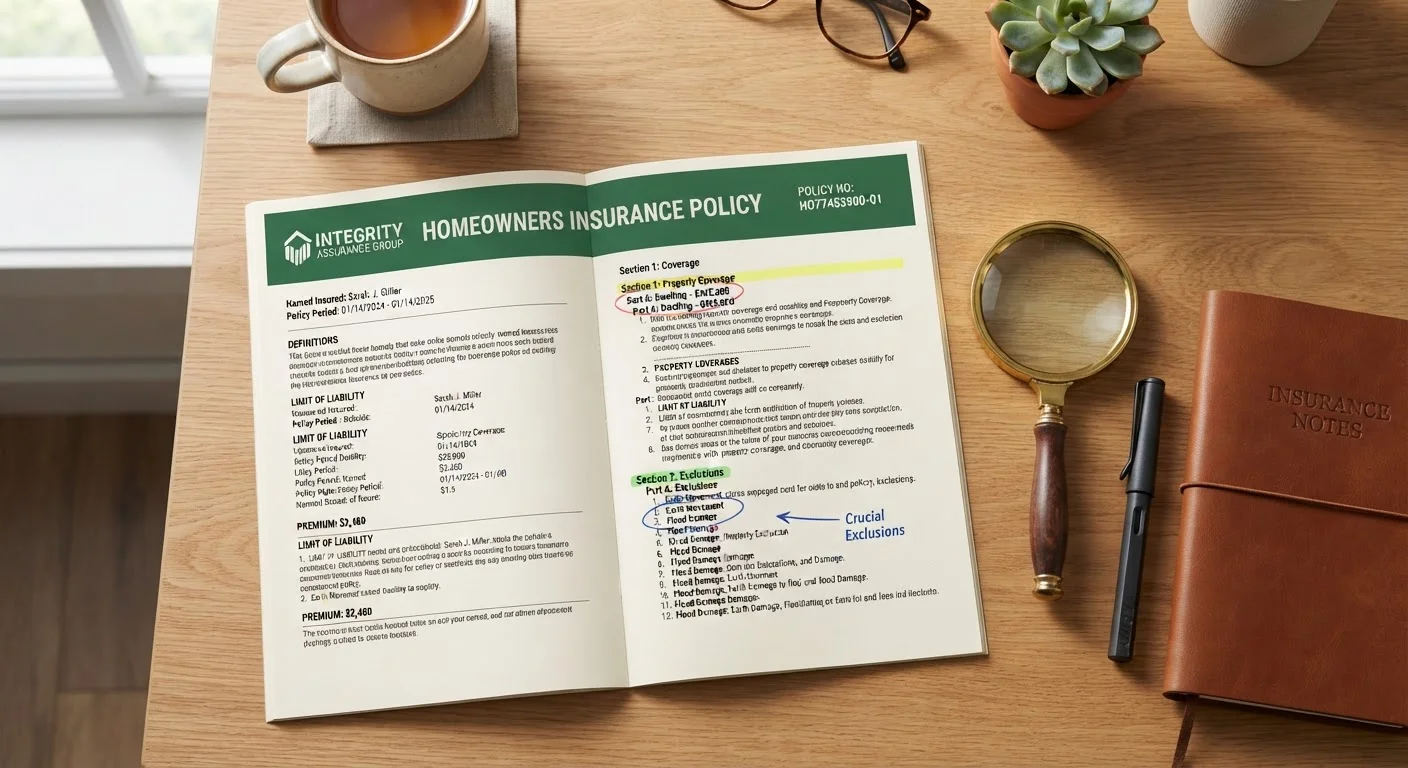

What an Exclusion Actually Does
When you buy an insurance policy, you are purchasing a contract. That contract lists what the insurer agrees to cover — but it also lists what it will not cover. Those carve-outs are called exclusions.
Think of a policy as a circle. Everything inside the circle is covered. Exclusions are the pieces cut out of that circle. If your loss lands inside one of those cut-out areas, your insurer can decline to pay — regardless of how long you have held the policy or how much you have paid in premiums.
Exclusions are not hidden in the fine print out of bad faith. They are a standard, legal part of insurance contracts, and regulators in most states require insurers to disclose them clearly. That said, they are easy to overlook if you never read past the declaration page. Understanding them is a core part of knowing what you actually own. For a broader look at policy language, the plain-language glossary of common insurance terms is a useful starting point.
Exclusions vs. Conditions: A Quick Distinction
Exclusions remove certain losses from coverage entirely. Conditions, by contrast, are requirements you must meet for coverage to apply — like notifying your insurer promptly after a loss. Both can affect a claim, but they operate differently. When reviewing a denial, it helps to identify which type of policy language the insurer is citing.
Why Insurers Use Exclusions
Exclusions are not arbitrary. They serve several practical purposes that affect everyone in the insurance pool.
- Managing predictable or uninsurable risk: Some losses — like a homeowner intentionally burning down their own house — are not accidents. Insuring deliberate acts would invite fraud and raise premiums for everyone.
- Separating coverage types: A standard homeowners policy is not designed to replace a health insurance plan. Medical payments from a car accident belong in auto insurance. Exclusions keep each policy focused on its intended purpose.
- Accounting for catastrophic or systemic risk: Events like floods, earthquakes, and wars can affect enormous numbers of people simultaneously. Standard policies often exclude these because no single insurer can absorb that level of loss. Separate, specialized coverage exists for many of them.
Understanding this logic helps policyholders see exclusions not as tricks, but as boundaries that define which product they have purchased. If your needs extend beyond those boundaries, the answer is usually a separate policy or an endorsement — not a different reading of the one you already have.
“An exclusion is essentially the insurer's way of saying: this risk is outside the scope of what you purchased. It's not a penalty — it's a boundary. The policyholder's job is to know where that boundary sits before they need to use their coverage.”
— Insurance Basics Editorial Team, Consumer insurance researchers and policy writers
Common Exclusions Across Policy Types
While exclusions vary by policy and insurer, certain categories appear across most common policy types:
- Intentional acts
- Damage you cause on purpose is nearly universally excluded.
- Wear and tear or maintenance failures
- Insurance covers sudden, accidental loss — not gradual deterioration. A leaking roof that has been ignored for years typically falls outside coverage.
- Flood and earthquake damage
- Standard homeowners and renters policies exclude these perils. Separate flood insurance (often through the National Flood Insurance Program) and earthquake policies exist to fill this gap.
- Pre-existing conditions (health insurance context)
- While federal law now limits how pre-existing condition exclusions can be applied in most health plans, some short-term or supplemental plans may still use them. Always verify with the specific plan.
- Business activities on personal policies
- Running a business from home, for example, can void certain homeowners coverage if business-related equipment or liability is involved.
For a side-by-side look at how exclusions interact with covered perils and endorsements, see this plain-language reference on covered perils and endorsements.
~40%
U.S. homeowners without flood insurance
According to FEMA estimates, a large share of homeowners in flood-prone areas lack separate flood coverage, partly because they assume their standard policy covers it — but flood is a near-universal exclusion.
1 in 5
Denied claims citing policy exclusions
Industry data consistently shows exclusions as one of the leading reasons insurers cite when denying property and casualty claims, underscoring the importance of reading policy documents carefully.
How to Handle Exclusions as a Policyholder
The most effective time to deal with exclusions is before you need to file a claim.
- Read the exclusions section when shopping. Ask your agent to walk you through the major exclusions in any policy you are considering. Compare how different policies define the same exclusion — the language matters.
- Identify your gaps. If you live in a flood zone, a standard homeowners policy is not enough. If you run a side business, a personal auto policy may not cover deliveries made for income.
- Ask about endorsements. An endorsement (sometimes called a rider) is an add-on that can modify or remove certain exclusions. Not every exclusion is removable, but many are — for an additional premium. See how these interact with your overall costs in our article on deductibles, premiums, and copays.
- Keep documentation. If a claim is denied citing an exclusion you believe does not apply, the burden of understanding the contract language is shared. Request the written denial, review the cited policy section, and contact your state's department of insurance if you believe the denial was improper.
Exclusions define the edges of your coverage. Knowing those edges — before a loss, not after — puts you in a much stronger position as a policyholder. For a deeper look at what your health plan specifically covers and excludes, see what health insurance actually covers.
Request a Summary of Key Exclusions
Before finalizing any policy, ask your agent or insurer for a plain-language summary of the most significant exclusions. Reputable insurers and agents should be able to walk you through these without requiring you to parse dense legal language on your own. This conversation is also a good time to ask whether endorsements are available to address any gaps you identify.
This article is for general informational purposes only and does not constitute insurance, legal, or financial advice. Coverage terms, exclusions, and regulations vary by insurer, policy type, and state. Consult a licensed insurance agent or adviser for guidance specific to your situation.