
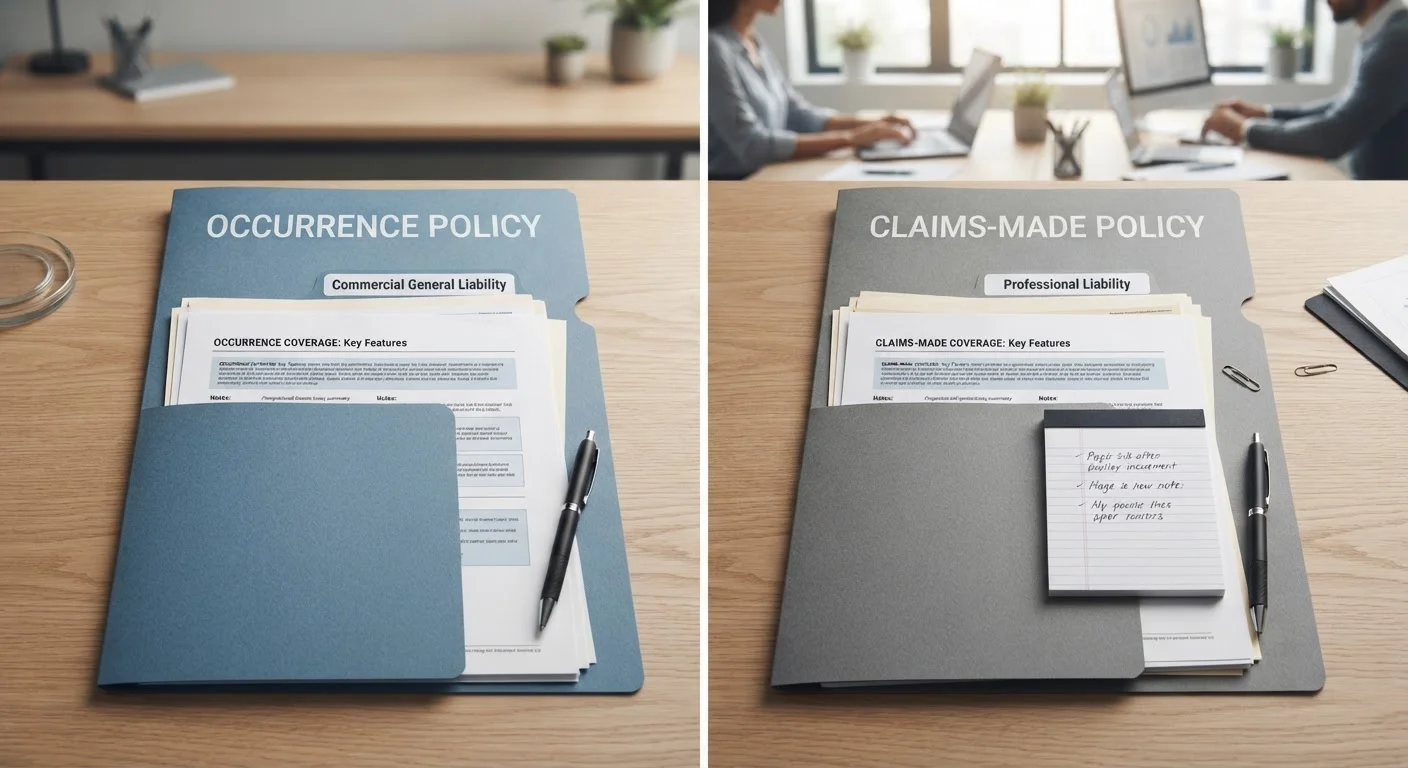
The Core Difference: When Does Coverage Turn On?
Every liability policy has a trigger — a rule that determines when the insurer is obligated to respond to a claim. Two fundamentally different triggers exist in the market, and understanding them is essential before you can evaluate any liability policy with confidence.
An occurrence policy is triggered by the date the injury or damage actually happened. If a covered incident occurs while the policy is active, the insurer must respond to a resulting claim — even if that claim is filed years, or in some cases decades, later. The policy period controls coverage, not the claim filing date.
A claims-made policy works differently. Coverage applies only when the claim is formally reported during the active policy period (or within a specified reporting window). If the policy has lapsed by the time someone files a claim against you, coverage generally does not apply — regardless of when the underlying incident occurred.
This distinction isn't just technical. It directly affects how exposed you are when policies expire, when you switch insurers, or when you retire. For more on how policy language shapes what you actually receive, see what qualifies as a covered peril.
How Each Structure Plays Out in Practice
Consider a contractor who completes a job in one year but a client doesn't discover alleged property damage until three years later. Under an occurrence policy active at the time of the work, the contractor's insurer from that period would typically respond — even if the contractor has since moved to a different carrier.
Under a claims-made policy, the insurer that's active when the claim is filed handles it, but only if the policy also covers that earlier date. This is where two important concepts come in:
- Retroactive date: The earliest incident date a claims-made policy will cover. Claims arising from incidents before this date are excluded.
- Tail coverage (Extended Reporting Period): An optional endorsement that extends the window to report claims after a claims-made policy ends. It's critical for anyone retiring, switching insurers, or closing a practice.
Without tail coverage, a gap exists the moment a claims-made policy lapses. This is one of the most common coverage surprises professionals face.
| Criterion | Occurrence Policy | Claims-Made Policy |
|---|---|---|
| Coverage trigger | Date of the incident | Date the claim is filed |
| Protection after policy ends | Yes, for covered incidents during policy period | Only with tail coverage purchased |
| Retroactive date concern | Not applicable | Yes — incidents before this date excluded |
| Common use cases | General liability, personal liability | Medical malpractice, E&O, D&O |
| Insurer-switching risk | Lower — prior policy still responds | Higher — gap possible without tail |
| Typical premium structure | Generally higher upfront | May be lower initially; tail adds cost |
Understanding how policy structures differ is as important as knowing which perils are covered. See our overview of major insurance coverage categories for broader context.
Who Typically Uses Which Structure — and Why
Occurrence policies are common in general liability coverage for businesses and in personal liability lines. They tend to carry higher premiums partly because the insurer's exposure extends indefinitely into the future after the policy period closes.
Claims-made policies dominate professional liability lines — medical malpractice, errors and omissions (E&O), and directors and officers (D&O) insurance, for example. In these fields, long latency periods between an alleged error and a formal complaint are common, making claims-made structures the market norm.
The 'Nose' vs. 'Tail' Terminology
In claims-made policies, 'tail coverage' extends reporting after a policy ends, while 'nose coverage' (also called prior acts coverage) is offered by a new insurer to cover incidents before the retroactive date. Both terms describe ways to fill the gaps that occur when claims-made policies transition. Ask your agent which option applies when you change carriers or retire.
Premium differences between the two structures are real but not uniform. A claims-made policy may appear less expensive initially, but tail coverage — if needed — can add significant cost at the end of the policy's life. Factor that into any long-term comparison.
Misreading your policy's trigger language is one of the more costly coverage misconceptions in insurance. For more examples of how assumptions can lead to surprises, see common insurance misconceptions that cost policyholders money.
This article provides general insurance information for educational purposes only. It is not legal or financial advice. Coverage terms, availability, and regulations vary by state and insurer. Consult a licensed insurance professional to understand how these concepts apply to your specific situation.