
Why Insurance Language Feels Foreign
Insurance policies are legal contracts, and they're written like it. The language is precise by design, but that precision can make even a simple policy feel like a foreign document when you're reading it for the first time. Terms like subrogation, coinsurance, and named peril don't appear in everyday conversation — which is exactly why so many people sign policies without fully understanding what they've agreed to.
The good news: the vocabulary is learnable, and once you know the foundational terms, you can apply them across almost every type of insurance you'll ever buy. Health, home, auto, and life policies all share a core set of concepts. Get comfortable with those, and the rest becomes much easier to navigate.
This article is for general informational purposes only and is not personalized insurance, financial, or legal advice. Coverage terms, exclusions, and rules vary by provider, policy, and state. Always read your actual policy documents and consult a licensed insurance professional for guidance specific to your situation.
The Core Terms Every Policy Uses
These terms show up on nearly every insurance policy regardless of type. Understanding them is the starting point for everything else.
Premium
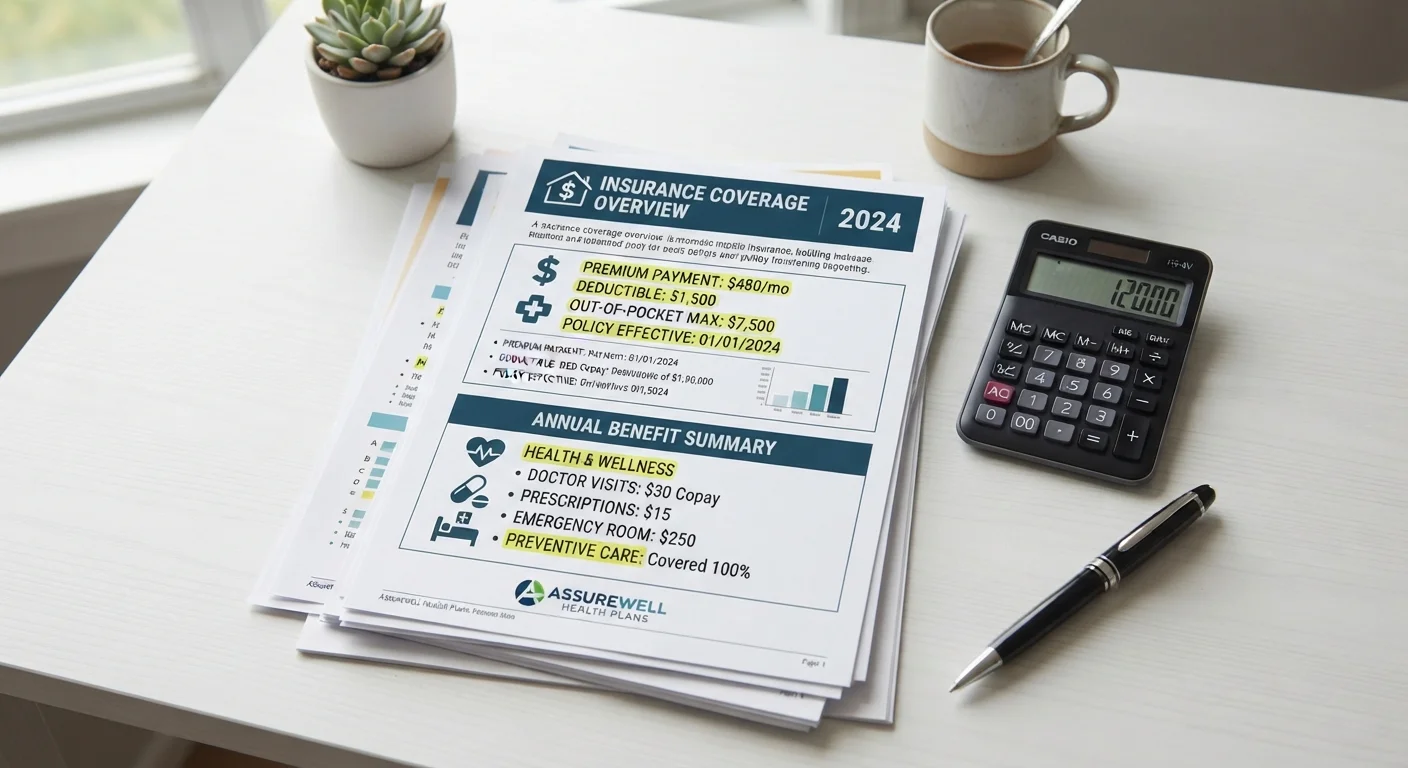
The amount you pay — usually monthly or annually — to keep your insurance policy active. You owe this even if you never file a claim.
Deductible
The amount you must pay out of pocket toward a covered loss before your insurer starts paying. A $1,000 deductible means you cover the first $1,000 of any claim.
Coverage limit
The maximum dollar amount your insurer will pay for a covered claim. Any costs above this limit are your responsibility.
Exclusion
A specific event, condition, or type of damage that your policy does not cover. Reading exclusions carefully helps you avoid surprises at claim time.
Claim
A formal request you submit to your insurer asking it to pay for a covered loss or event. Filing a claim starts the process of receiving a payout.
Policyholder
The person or entity that owns the insurance policy and is responsible for paying the premium.
Insured
The person or property covered by the policy. The policyholder and the insured are often the same person but don't have to be.
Underwriting
The process insurers use to evaluate risk and decide whether to offer you a policy and at what price. Your age, health, driving record, or home location can all factor in.
Beyond these definitions, it helps to know the relationship between them. A lower premium often means a higher deductible — you pay less each month, but more when something goes wrong. Your coverage limit caps what the insurer will pay, and anything above that limit comes out of your pocket. Exclusions define the boundaries of what's covered at all.
For a closer look at how premiums, deductibles, and copays interact in practice, see our detailed breakdown of those three terms.
Terms Specific to Common Policy Types
While the core vocabulary applies broadly, each major insurance category introduces its own terminology.
Health Insurance
Copay: A fixed dollar amount you pay for a specific service — a doctor visit or prescription — at the time of service. Coinsurance: After you meet your deductible, coinsurance is the percentage of costs you share with your insurer. An 80/20 split means the insurer pays 80% and you pay 20%. Out-of-pocket maximum: The most you'll pay in a policy year before your insurer covers 100% of eligible costs.
Homeowners Insurance
Dwelling coverage: Pays to repair or rebuild the structure of your home after a covered loss. Personal property coverage: Covers your belongings inside the home. Liability coverage: Protects you if someone is injured on your property and you're found responsible. For definitions of covered perils and exclusions specific to home policies, see our plain-language reference on covered perils and exclusions.
Auto Insurance
Collision coverage: Pays for damage to your vehicle from a crash, regardless of fault. Comprehensive coverage: Covers non-collision events like theft, weather, or animal strikes. Liability coverage: Required in most states; covers damage or injury you cause to others.
Life Insurance
Death benefit: The lump sum paid to your beneficiary when you die. Beneficiary: The person or entity you name to receive that benefit. Term vs. permanent: Term policies cover a set number of years; permanent policies (like whole life) are designed to last your lifetime and may include a cash value component.
Name and Update Your Beneficiaries
Life events like marriage, divorce, or having children can make your existing beneficiary designation outdated. Review your beneficiary information whenever a major life change occurs. An outdated designation can mean the wrong person receives your death benefit — or the process is delayed.
How to Read a Policy Without Getting Lost
Every policy includes a declarations page (often called the "dec page") — a summary at the front that lists your coverage types, limits, deductibles, policy period, and premium. Start here whenever you need a quick overview.
The main body of the policy — called the insuring agreement — describes what the insurer promises to cover. The conditions section explains your obligations as the policyholder, such as how to report a claim and how quickly you must do so. The exclusions section is where many people are surprised: this is the list of what's not covered.
Don't Rely Only on Summaries
Insurance summaries and marketing materials simplify coverage for quick reading — but the actual policy document is what controls your claim. If there's ever a conflict between a summary and the policy text, the full policy language governs. Always review the complete document, especially the exclusions section, before assuming you're covered.
If something in your policy is unclear, you don't have to guess. A licensed insurance agent can walk you through specific language. You can also find state-specific consumer guides through your state's department of insurance.
Where to Go from Here
This vocabulary gives you a working foundation, but insurance language goes deeper. Our glossary of terms that confuse most policyholders covers more advanced concepts — from riders to subrogation — in the same plain-language format.
When you're ready to evaluate an actual policy, use our checklist of questions to ask before signing to make sure you understand what you're committing to. And if you want to understand the broader landscape of what's available, our overview of coverage types explains the major categories of insurance most Americans encounter.
Knowing the language doesn't make every insurance decision easy — but it does put you in a much stronger position to ask the right questions, compare options accurately, and understand what your policy actually does when you need it most.
Your State's Department of Insurance
Every US state has a department of insurance that publishes consumer guides, explains your rights as a policyholder, and handles complaints. Search for your state's department online for free, official resources.
NAIC Consumer Information Source
The National Association of Insurance Commissioners provides a public tool to look up insurer complaint records and licensing information, helping you evaluate the companies you're considering.