Why Enrichment Matters More Than Most Owners Realize
An indoor pet that tears up furniture, over-grooms, or paces repetitively isn't being difficult — it's communicating. Chronic under-stimulation can manifest as anxiety, destructive behavior, or even physical health problems over time. As explored in our guide on mental stimulation vs. exercise, the two serve very different biological functions: exercise burns energy, while enrichment engages the brain's problem-solving and sensory systems.
The good news is that effective enrichment doesn't require expensive gear or hours of prep. What it does require is understanding what each species finds genuinely rewarding — which varies considerably between a dog, a cat, and a rabbit. The list below translates current animal behavior research into practical strategies you can start using today.
Start Simple, Then Build Complexity
If your pet is new to enrichment, introduce one activity at a time rather than overhauling their environment all at once. Overwhelming novelty can cause anxiety rather than engagement, particularly in shy or rescue animals. Observe how your pet responds — active investigation and relaxed body language are positive signs. Gradually layer in additional enrichment as confidence grows.
7 Enrichment Strategies That Actually Work
Scent Work and Nosework Games
A dog's nose contains roughly 300 million olfactory receptors — compared to about six million in humans. Giving dogs dedicated sniffing tasks satisfies a deep neurological drive. Hide small amounts of a high-value food in muffin tins covered with tennis balls, scatter treats in a snuffle mat, or teach a simple nose-touch cue to a hidden scent. Cats and rabbits benefit from scent work too: rotating novel objects with outdoor scents (pine cones, dried herbs, pet-safe botanicals) into their space provides low-effort olfactory novelty.
Sniffing engages a dog's brain more deeply than a brisk walk of the same duration.
Puzzle Feeders and Foraging Devices
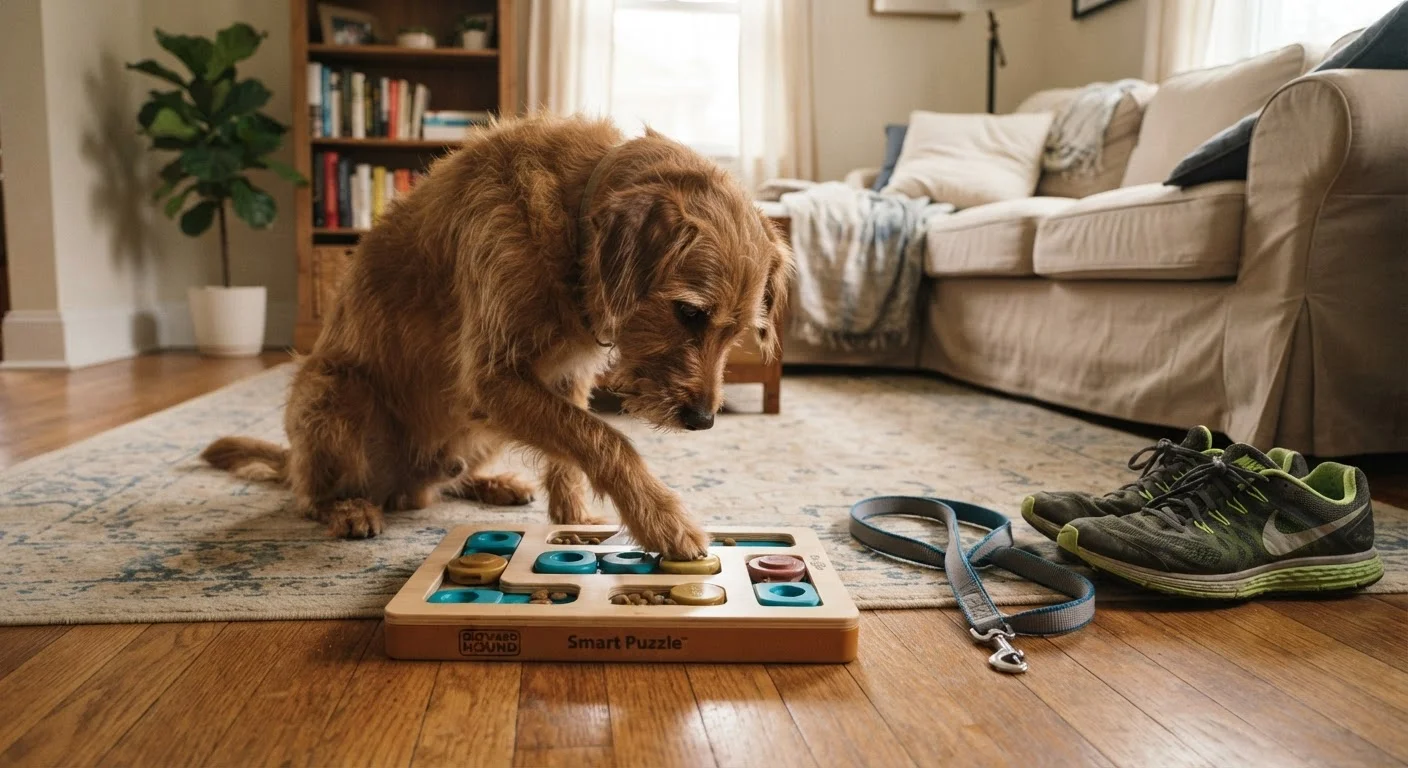
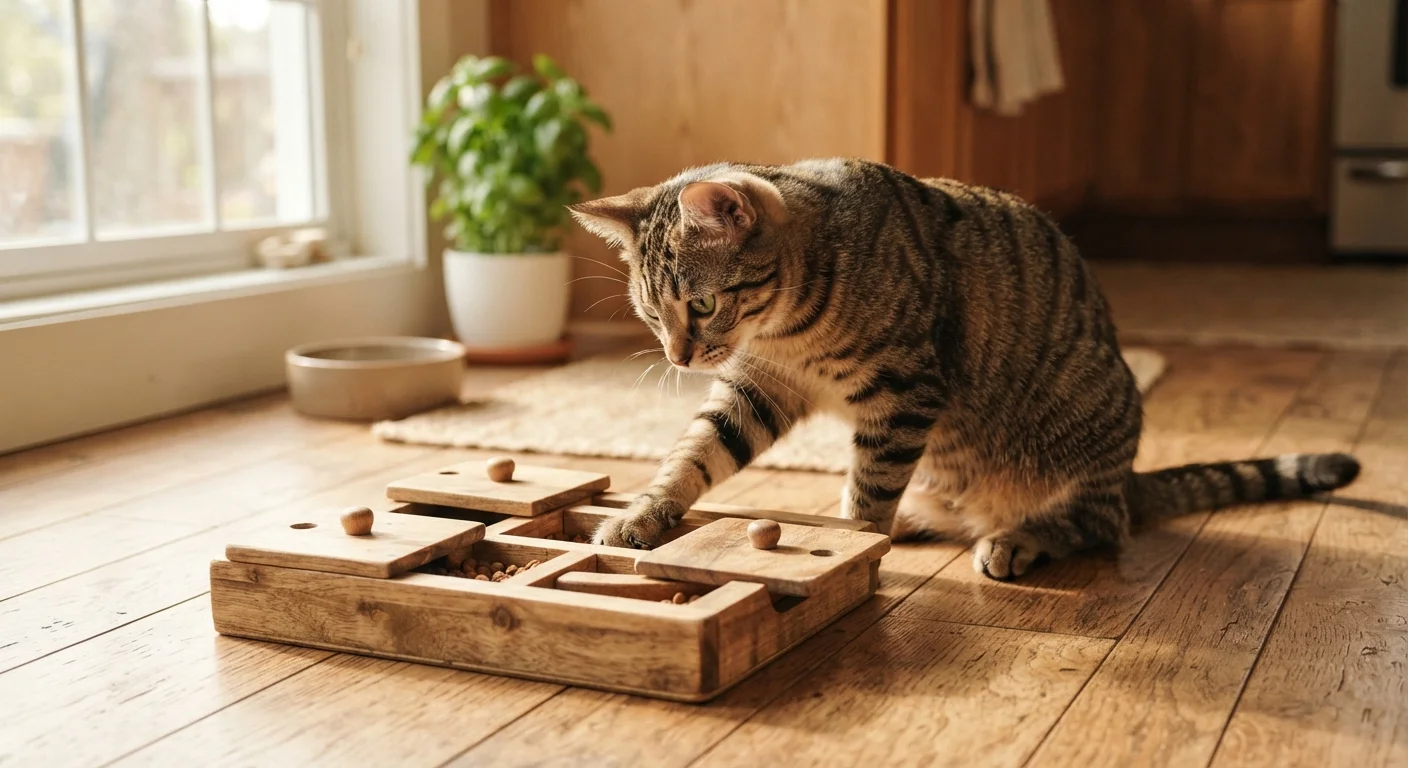
Wild ancestors of domestic pets spent the majority of their waking hours locating food. Delivering every meal in a bowl removes that entire behavioral loop. Puzzle feeders — which require an animal to manipulate, roll, or excavate to access food — reintroduce mild cognitive challenge at mealtime. Start with a low-difficulty level and progress as your pet masters each stage; frustration that leads to giving up indicates the task is too hard, not that the animal is uninterested. For small mammals like guinea pigs and hamsters, hiding pellets in shredded paper bedding accomplishes the same goal with zero equipment cost.
Replacing a single daily meal with a foraging device can noticeably reduce restlessness.
Vertical Space and Environmental Complexity
Cats are vertical animals — height conveys safety and territory in feline communication. A home that offers only floor-level space is cognitively impoverished for a cat, regardless of its square footage. Shelves, cat trees, and window perches with an outdoor view address this directly. For dogs, rearranging furniture paths or introducing novel textures (a rubber mat, a crinkle surface) into their walking environment creates low-level novelty that prompts exploratory behavior. Even small animals like hamsters and rats show measurable stress reduction when offered multi-level cage configurations. If you share your home with multiple species, managing enrichment across species requires some additional planning to ensure each animal has safe, uncontested access to their resources.
For cats, vertical space is not a luxury — it is a fundamental environmental need.
Training Sessions as Mental Exercise
Short, reward-based training sessions — even five to ten minutes — provide concentrated cognitive engagement that many pets find more tiring than physical exercise. Teaching a new behavior, practicing a sequence of known cues, or working on impulse-control exercises all draw on working memory and attention. Positive reinforcement methods are well-supported by behavioral science and tend to build a stronger human-animal bond alongside the cognitive benefit. Cats, rabbits, and even some birds are fully capable of learning cue-response chains — training isn't just for dogs.
A ten-minute training session can be more mentally exhausting for a dog than a thirty-minute walk.
Sensory Variety Through Sound, Texture, and View
Indoor environments tend to be acoustically and visually static — the same sights, sounds, and surfaces day after day. Introducing controlled sensory variety helps. Bird feeders placed outside a window give cats and small birds hours of visual stimulation at no cost. Calming species-appropriate audio (low-frequency classical music has shown some benefit for kenneled dogs in research settings) can reduce ambient stress. For cats kept strictly indoors, research on indoor cat welfare consistently highlights environmental complexity — not just floor space — as the key variable in behavioral outcomes. Rotate novel textures (a paper bag to investigate, a cardboard tunnel to explore) weekly to prevent habituation.
A bird feeder outside the window is one of the simplest, most effective enrichment tools for indoor cats.
Social and Interaction-Based Enrichment
For social species — dogs, parrots, guinea pigs, and rats among them — quality time with humans or compatible conspecifics (animals of the same species) is itself a form of enrichment. This doesn't mean continuous attention; it means structured, interactive engagement: a play session with a wand toy, a hand-feeding exercise, or even grooming, which many animals find calming. Building positive associations around grooming can double as a bonding enrichment activity when approached with patience and reward-based handling.
For social species, structured interaction time is enrichment — not just affection.
Rotating and Novelty-Based Enrichment
Even the most stimulating environment loses its effect if it never changes. Animals habituate — what was novel and engaging on day one becomes invisible by day thirty. The solution isn't to constantly buy new items, but to rotate what's available. Store half your pet's toys and environmental objects and swap them out every one to two weeks. Reintroduced items are processed as novel stimuli. This principle applies across species: a rabbit that ignores a cardboard box after a week will often re-engage when it reappears a month later. Rotate substrates, hides, foraging setups, and play objects on a staggered schedule to keep the environment perpetually interesting.
Rotating toys back into use after a break is more effective than constantly buying new ones.
Species Differences Matter Significantly
What counts as enriching varies by species, breed, age, and individual temperament. A herding dog needs cognitively demanding tasks; a senior cat may prefer passive sensory novelty. An enrichment strategy that works beautifully for one animal may cause frustration or stress in another. If you're unsure what's appropriate for your specific pet, a veterinarian or certified animal behaviorist can provide tailored guidance.
Building Enrichment Into Daily Life
The most effective enrichment isn't a once-a-week event — it's woven into the fabric of daily care. Swapping a portion of your pet's meal into a foraging device, rotating a few novel objects into their space each week, or spending five minutes on scent work before a training session all add up quickly. If you've recently welcomed a new animal home, our first-week guide for new pet owners walks through how to build routines that include stimulation from day one.
Be mindful, too, that some well-meaning habits can inadvertently reduce enrichment. Feeding every meal from a bowl, keeping the environment completely static, or ignoring signs of frustration are all patterns worth reconsidering. See everyday habits that quietly undermine your pet's health for a fuller picture. Small, consistent changes — not dramatic overhauls — are what sustainably improve a pet's quality of life indoors.
This article is for general informational purposes only and is not a substitute for professional veterinary advice. If your pet is showing signs of severe anxiety or compulsive behavior, consult a licensed veterinarian or certified animal behaviorist.