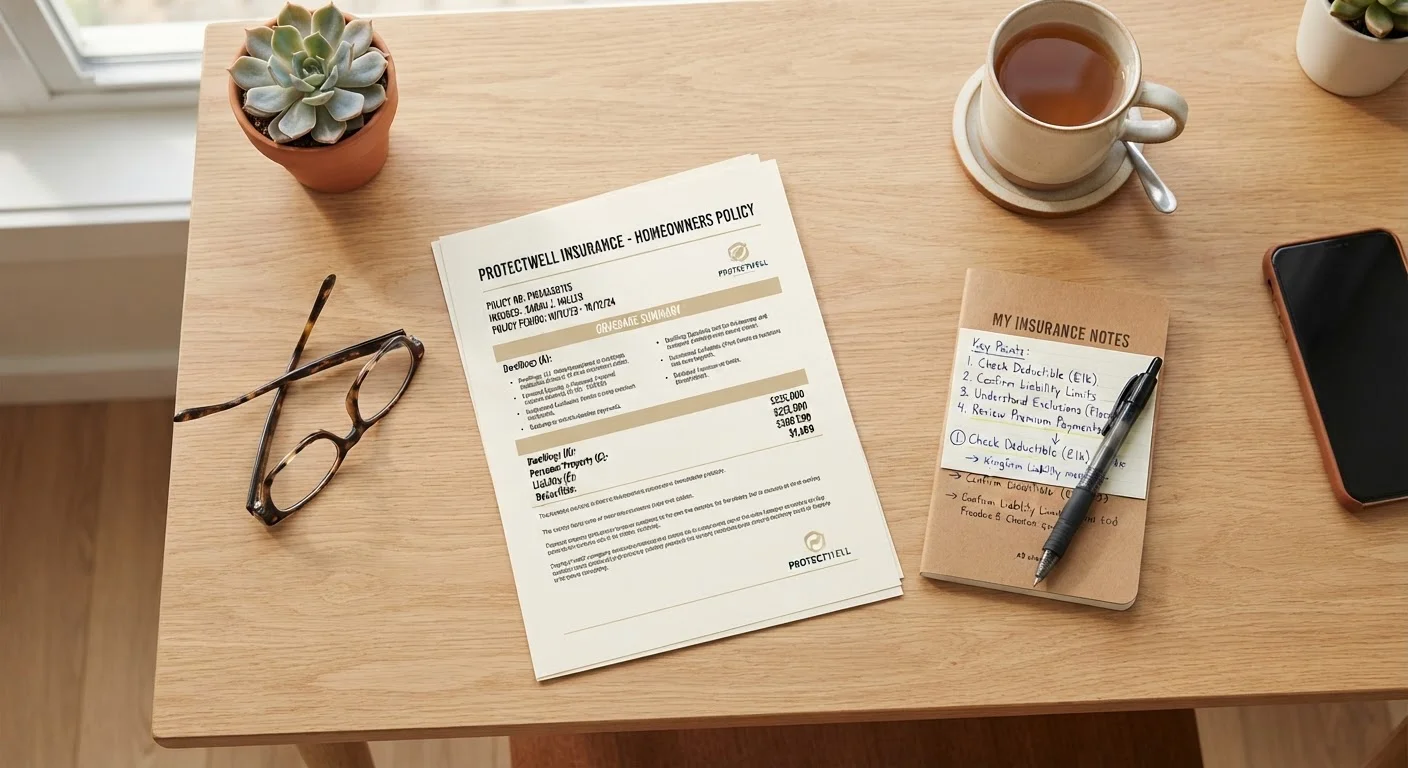

What Is a Declarations Page and Why Does It Matter?
When an insurer issues a policy, they also produce a declarations page — a concise, one-to-two-page summary that sits at the front of your policy documents. Think of it as the cover sheet: it captures the who, what, when, and how much of your coverage without forcing you to read dozens of pages of policy language.
You receive a new or updated dec page every time your policy is issued, renewed, or significantly changed. Lenders and landlords routinely ask for it as proof of insurance because it quickly shows coverage types and limits.
The Dec Page Is a Summary, Not the Full Policy
Your declarations page lists coverage types and limits, but it does not spell out every exclusion, condition, or definition. Before assuming something is covered, check the full policy document — especially the exclusions section. If you are unsure, call your insurer and ask for clarification in writing.
Understanding your dec page does not replace reading your full policy, but it gives you a reliable at-a-glance reference. Once you know what each section means, you can catch errors, verify your coverage is what you intended, and be better prepared when it is time to understand a claims summary or explanation of benefits.
How to Read Each Section of Your Dec Page
The steps below walk through a typical declarations page from top to bottom. While exact layouts vary by insurer and policy type, the core sections appear in nearly every dec page across health, auto, home, and renters policies. If any of the terms below are unfamiliar, start with our foundational insurance vocabulary guide before continuing.
What you will need
Locate the Named Insured and Policy Information
The very top of a declarations page — often called the "dec page" — lists the named insured: the person or entity the policy legally belongs to. This is usually the primary policyholder. Below that you will typically find the insurer's name, the policy number, and the policy period (the start and end dates of your coverage).
Check that your full legal name and address are spelled correctly. An error here is worth fixing immediately.
Identify the Type of Insurance and What Is Being Covered
Just below the basic identifying information, the dec page specifies what kind of policy this is — auto, homeowners, renters, life, and so on — and describes the insured item or property. For an auto policy, this is your vehicle's year, make, model, and VIN. For homeowners, it is your property address and a brief description.
Confirm that the described property or vehicle matches what you actually own. If you have made changes — added a vehicle, moved, or renovated — verify those updates are reflected.
Read the Coverage Sections and Their Limits
This is the most detail-dense part of the dec page. Coverage is usually listed in a table, with each coverage type paired with a coverage limit — the maximum dollar amount your insurer will pay for a covered loss under that category.
Common examples:
- Liability coverage: pays others if you cause damage or injury
- Dwelling coverage (homeowners): pays to rebuild or repair your home's structure
- Personal property coverage: covers your belongings
- Collision / Comprehensive (auto): covers vehicle damage
For a deeper look at how coverage categories work, see our Coverage Types hub.
Find Your Deductible for Each Coverage
The deductible is the amount you pay out of pocket before your insurance kicks in on a claim. It is usually listed next to or beneath each coverage type. Different coverages can carry different deductibles — for example, your homeowners policy may have a standard deductible for most claims but a separate, higher deductible for wind or hail damage.
Higher deductibles typically mean lower premiums, and vice versa. Make sure the deductibles listed match what you agreed to when you bought or renewed the policy.
Confirm the Premium and Any Discounts or Endorsements
The premium is what you pay for the policy — usually shown as an annual total and sometimes broken into installment amounts. The dec page may also list any discounts applied (such as multi-policy or safety-device discounts) and any endorsements — add-ons that modify standard coverage.
Endorsements are particularly important: they can expand coverage (adding flood protection, for example) or restrict it. If you see an endorsement you do not recognize, look it up in your full policy document or ask your agent. For more on how endorsements shape what is and is not covered, see our plain-language reference on covered perils and endorsements.
Note Additional Insureds, Lienholders, and Contact Information
Some dec pages list additional insureds (others with coverage interests, such as a landlord on a renters policy) or lienholders (such as a mortgage lender or auto lender who has a financial stake in the insured property). This section also typically includes contact information for claims and customer service.
Make sure any lender listed matches your current loan — outdated lienholder information can delay claim payouts.
Keep Your Dec Page Easy to Find
Store a digital copy of your current declarations page in a cloud folder or email it to yourself. If you ever need to file a claim quickly, you will want your policy number, insurer contact, and coverage limits at hand without digging through paper files.
Errors on Your Dec Page Can Affect Claims
If your name, address, or property description is incorrect on the declarations page, it could complicate a future claim. Review every new or renewed declarations page for accuracy within the first few days of receiving it. Contact your insurer or agent promptly if anything looks wrong — corrections are usually straightforward but time-sensitive.
After working through each section, you should have a clear picture of who is covered, what property or risk is insured, how much the insurer will pay for a covered loss, what you owe as a deductible, and what the policy costs. If your dec page raises questions about what is actually covered versus excluded, our guide to what health insurance actually covers (for health policies) and our Claims and Coverage Tips hub are useful next reads.
This article is for general informational purposes only and does not constitute personalized insurance, legal, or financial advice. Coverage terms, limits, and regulations vary by insurer, policy type, and state. Always read your actual policy documents and consult a licensed insurance agent or adviser for guidance specific to your situation.