The Six Required Elements on Every U.S. Pet Food Label
Federal and state regulations require commercial pet foods sold in the United States to display six core elements on every package. Knowing what each one communicates — and what it doesn't — is the foundation of label literacy.
- Product name: Governed by specific naming rules. If a single ingredient is named (e.g., "Chicken for Dogs"), it must make up at least 95% of the formula by weight excluding water. "With Chicken" requires only 3%. These thresholds are regulated by AAFCO and matter more than they appear to.
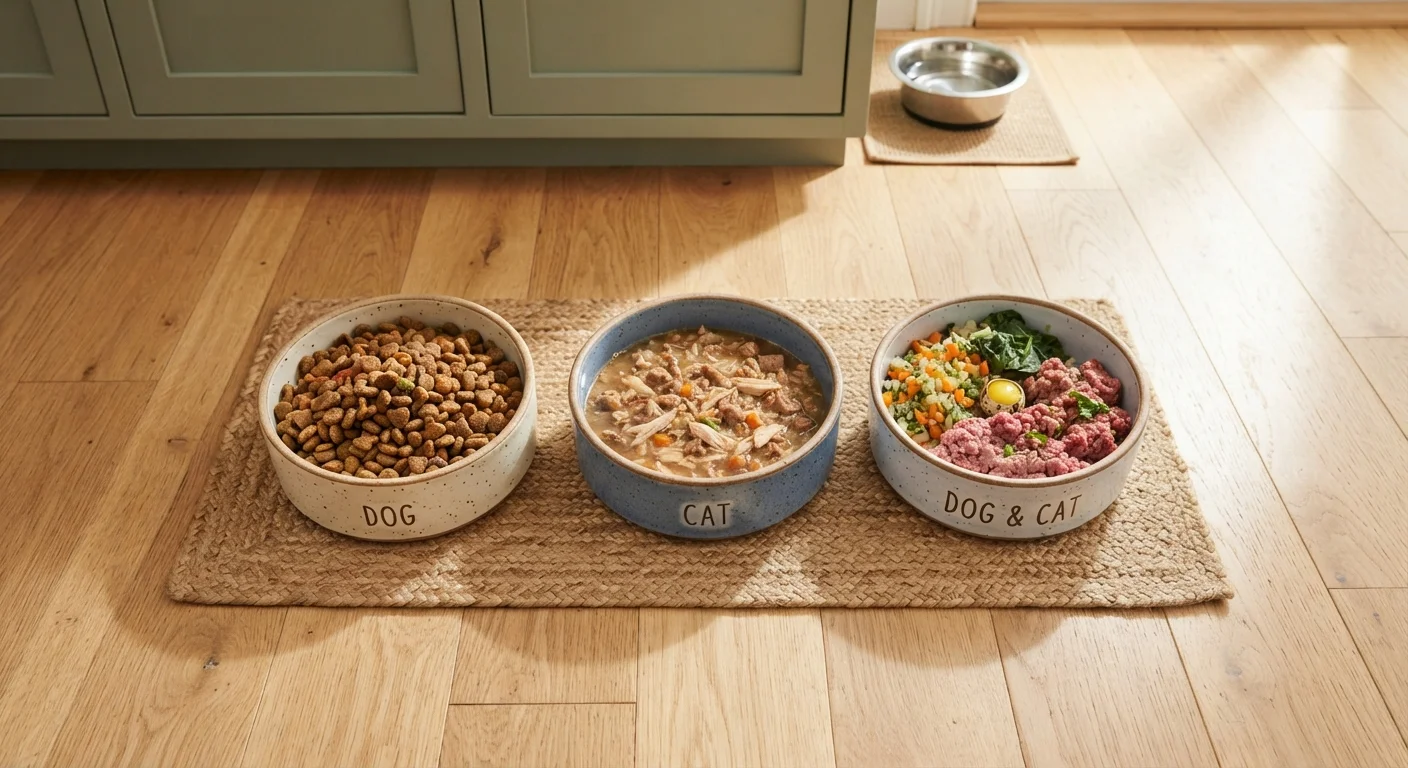
- Species designation: The label must specify the intended animal — dog, cat, or other. Formulas are not interchangeable; cat food, for example, contains taurine at levels dogs don't require, while some dog foods lack nutrients cats need.
- Net weight
- Manufacturer's name and address
- Ingredient list
- Guaranteed analysis
The last two elements deserve deeper attention, which is where most label confusion arises.
FDA and AAFCO: Different Roles
The FDA regulates pet food safety under federal law — covering contaminants, labeling accuracy, and manufacturing standards. AAFCO is a non-governmental organization whose model regulations are adopted by individual states to define nutrient standards and labeling language. Both influence what appears on the labels you read, but neither 'approves' individual pet food products before sale.
Reading the Ingredient List: What Order Really Tells You
Ingredients are listed in descending order by pre-processing weight — meaning moisture is factored in. A whole chicken listed first may contain roughly 70% water, so after cooking it contributes far less protein by weight than its top-of-list position suggests. "Chicken meal," by contrast, is already dehydrated and can be a more concentrated protein source despite appearing lower on the list.
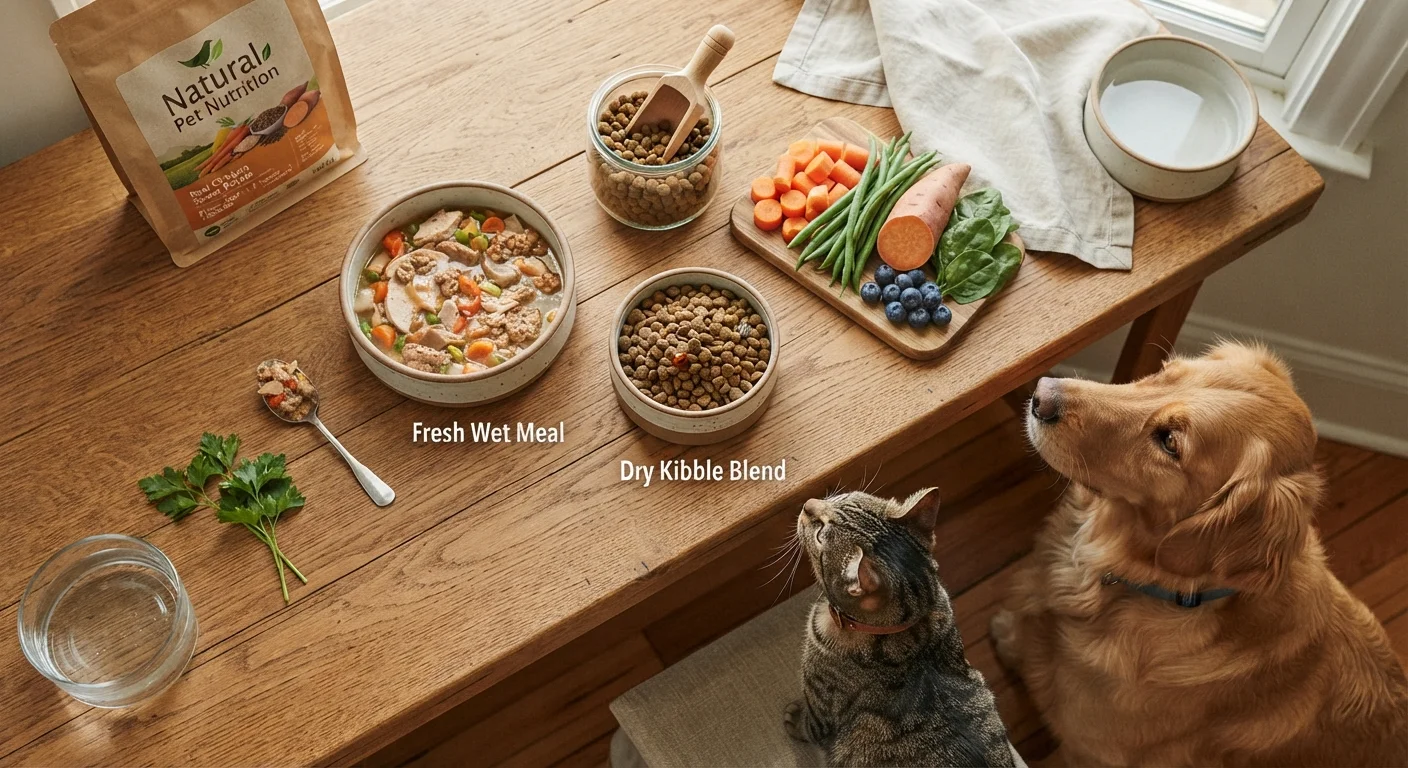
This doesn't mean ingredient order is meaningless. It still signals which components make up the bulk of the formula. But it is worth pairing the ingredient list with the guaranteed analysis to get a fuller picture. For a deeper look at how diet formats affect ingredient composition, see our guide on dry food, wet food, and raw diets.
Ingredient splitting — listing variations of the same ingredient separately (e.g., "ground corn," "corn gluten meal," "corn flour") — can push a single ingredient lower on the list even when it collectively dominates the formula. It's a legal practice, but worth recognizing.
Look Past the Front-of-Bag Claims
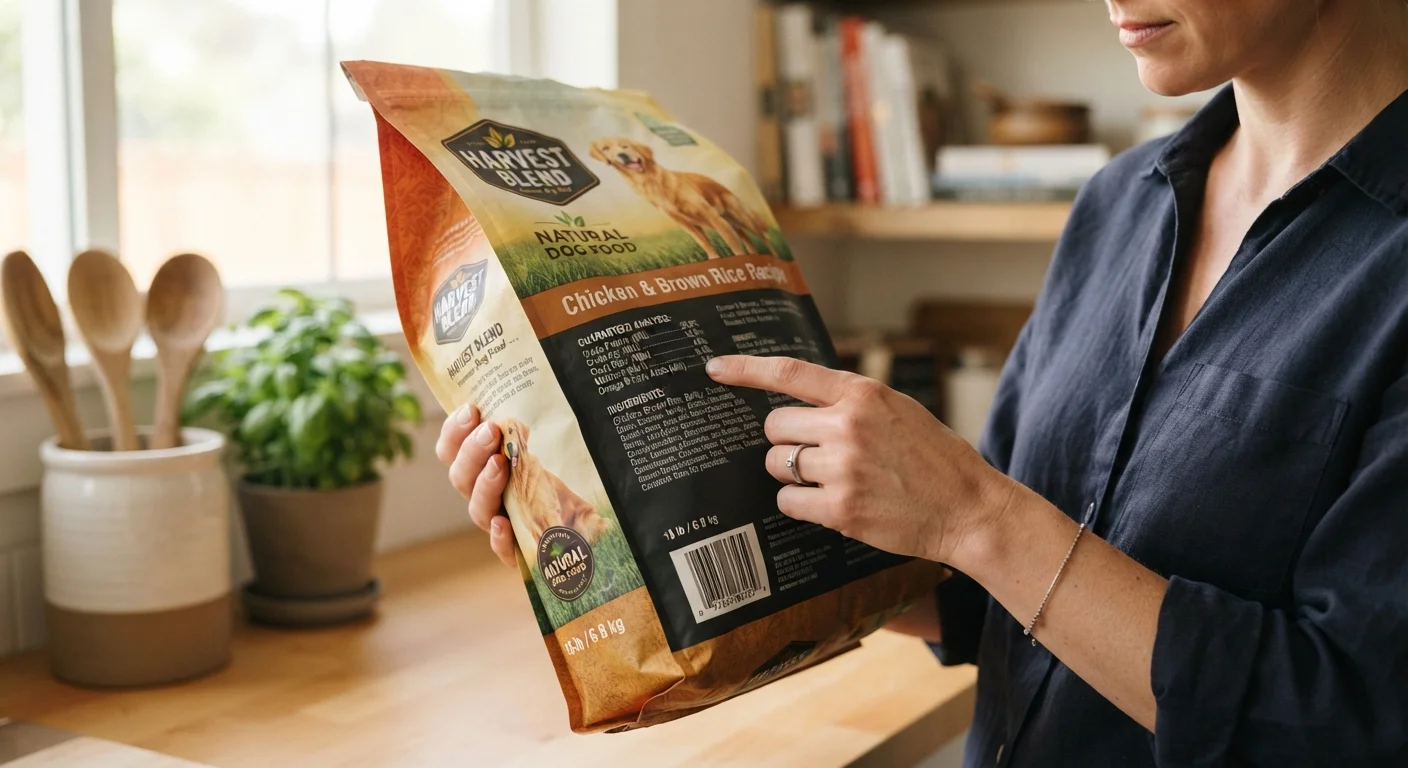
Words like 'natural,' 'holistic,' and 'premium' have no standardized regulatory definition in pet food labeling. They are marketing language, not nutritional certifications. The back panel — ingredient list, guaranteed analysis, and AAFCO statement — is where the regulated, meaningful information lives. Train yourself to flip the bag first.
The Guaranteed Analysis: Percentages in Context
The guaranteed analysis panel lists four required values: minimum crude protein, minimum crude fat, maximum crude fiber, and maximum crude moisture. These are not averages or targets — they are regulatory boundaries. The actual amounts in the bag or can may be higher than the minimums stated.
95%
Threshold for single-ingredient product name rule
Under AAFCO model regulations, a product named after one ingredient (e.g., 'Beef for Dogs') must contain at least 95% of that ingredient by weight, excluding water used in processing.
3%
Minimum required for 'With [Ingredient]' labeling
AAFCO rules allow 'With Chicken' or similar phrasing when the named ingredient makes up just 3% or more of the formula — a much lower bar than the primary name rule.
70–85%
Typical moisture content of canned wet pet food
Because wet foods contain so much water, as-fed nutrient percentages are substantially diluted compared to dry kibble; dry-matter conversion is needed for accurate comparison.
Comparing wet and dry food using as-fed percentages is misleading because wet food contains 70–85% moisture while dry kibble contains around 10%. To compare nutrient density fairly, convert both to a dry-matter basis: subtract the moisture percentage from 100 to get the dry matter percentage, then divide the nutrient percentage by that number. For example, a wet food with 10% crude protein and 78% moisture has a dry-matter protein of roughly 45% — considerably higher than the as-fed figure suggests.
This math matters most when your veterinarian recommends a higher-protein or lower-phosphorus diet for a pet with specific health needs. For context on how weight and diet intersect, the article on weight management in dogs and cats covers how nutrition choices affect body condition over time.
The AAFCO Statement: The Most Important Line on the Label
The nutritional adequacy statement — often called the AAFCO statement — is the single most informative line on any commercial pet food package. It takes one of two forms:
- Formulated to meet AAFCO nutrient profiles — the manufacturer calculated that the recipe meets AAFCO's published minimums for a stated life stage. No live animals were tested.
- Substantiated by AAFCO feeding trial protocols — the food was actually fed to animals under controlled conditions and found to support the stated life stage. This is generally considered the more rigorous standard.
The life stage listed matters: "growth and reproduction" covers puppies and kittens; "adult maintenance" covers healthy adult animals; "all life stages" meets the highest thresholds. A food labeled only for "supplemental feeding" or "intermittent use" is not formulated to stand alone as a complete diet.
“The nutritional adequacy statement is the most important thing on a pet food label. Everything else is secondary to knowing whether that food is complete and balanced for your pet's life stage.”
— American Veterinary Medical Association, Veterinary professional organization representing U.S. veterinarians
Many of the persistent beliefs owners hold about pet nutrition — such as grain-free diets being universally healthier — aren't supported by the label evidence. For a broader look at what the research actually shows, see our article on common pet nutrition myths.
This article is for general informational purposes only and does not constitute veterinary or dietary advice. Always consult a licensed veterinarian before making significant changes to your pet's diet, particularly if your pet has a health condition.