The One Rule That Changes Everything: Order Matters
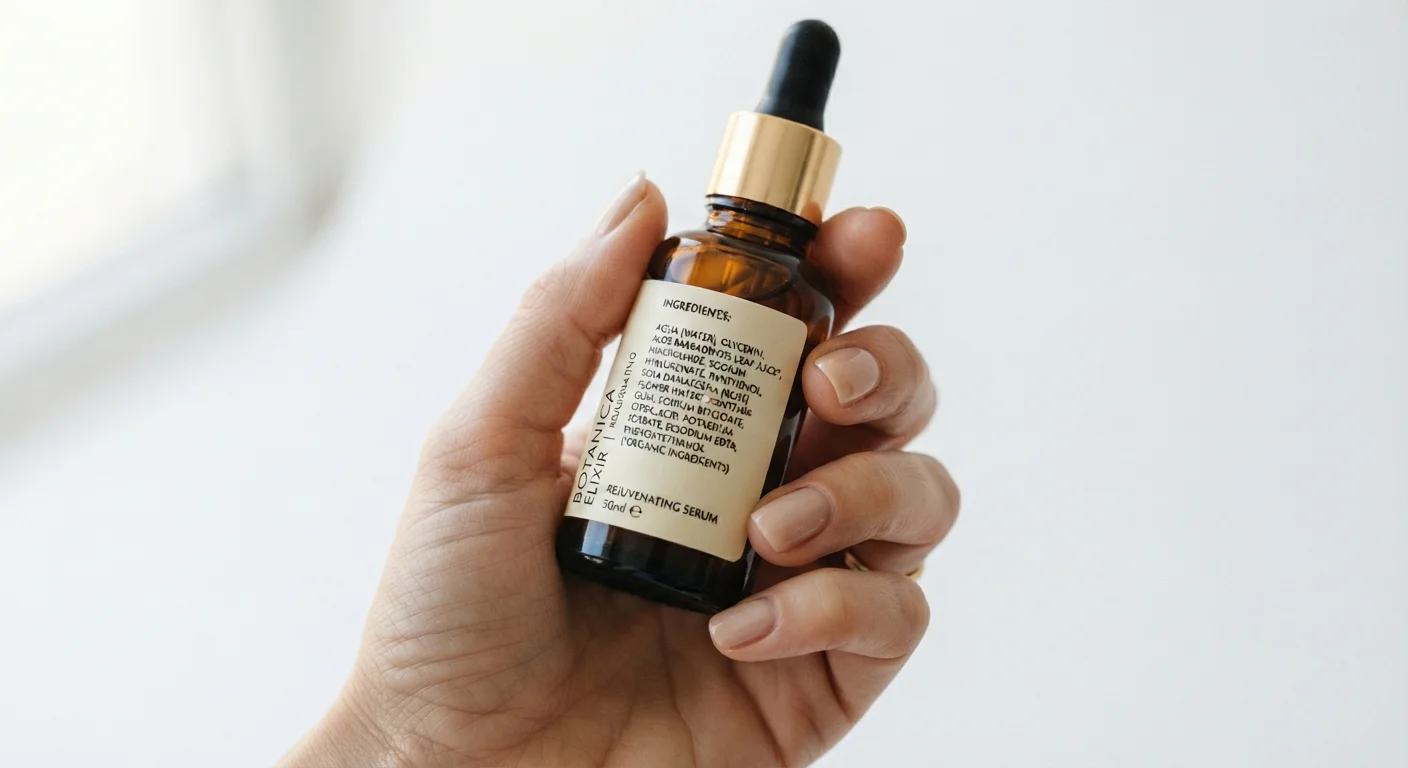
Every skincare ingredient list in the U.S. follows a rule set by the FDA: ingredients are listed in descending order by concentration. Whatever appears first makes up the largest percentage of the formula; whatever appears last is present in the smallest amount. That single fact gives you a huge amount of information before you even look up a single ingredient.
In practice, the first five or so ingredients typically account for the bulk of the product — often 80–95% of the formula. So if water (aqua) is first and glycerin is second, you're holding a water-based, humectant-forward formula. If a buzzy active like niacinamide appears near the bottom of a long list, it's likely at a low concentration.
Ingredients present at 1% or less can be listed in any order after the main ingredients. This is why preservatives, fragrances, and some actives often cluster toward the end — they work at low levels, not because they're unimportant. To understand how ingredients like fragrance function in a formula and why they matter, it helps to read the full label in context.
| Listing order standard | Descending by concentration (highest to lowest) (U.S. FDA cosmetic labeling regulations) |
| Threshold for any-order listing | Ingredients at 1% or less may be listed in any order (21 CFR Part 701) |
| Naming system used | INCI (International Nomenclature of Cosmetic Ingredients) (Global cosmetic industry standard) |
| Typical formula bulk | First 5 ingredients often represent ~80–95% of the formula (General cosmetic chemistry guidance) |
| Fragrance disclosure | May appear as 'parfum,' 'fragrance,' or individual components like linalool (EU-influenced labeling increasingly adopted by U.S. brands) |
Decoding the Language: Latin Names, Synonyms, and What to Look For
Skincare labels use INCI (International Nomenclature of Cosmetic Ingredients) naming — a standardized system that uses Latin botanical names and chemical nomenclature. It sounds intimidating, but there's a simple pattern once you get familiar with it.
- Plant-derived ingredients appear as their Latin genus and species name: Aloe barbadensis leaf juice = aloe vera.
- Synthetic ingredients use chemical names: dimethicone is a silicone used for smoothing; tocopherol is vitamin E.
- Acids like glycolic, lactic, and salicylic acid usually appear in plain English, making them easier to spot.
- Fragrance may appear as parfum, fragrance, or hidden within terms like linalool or limonene — these are individual fragrance components disclosed separately under EU-influenced labeling practices increasingly adopted by U.S. brands.
You don't need to memorize every name. A reliable approach: identify the first five ingredients (the formula's backbone), then scan for any actives or sensitizers you personally track. If you're building or refining a routine, see how product formulas fit together in our guide to layering skincare products in the right order.
INCI
International Nomenclature of Cosmetic Ingredients — the standardized system used globally to name cosmetic ingredients on product labels. It ensures consistency across brands and countries.
Humectant
An ingredient that draws moisture into the skin from the environment or deeper skin layers. Common examples include glycerin and hyaluronic acid.
Emollient
An ingredient that softens and smooths skin by filling gaps in the skin's surface. Oils, butters, and silicones like dimethicone are typical emollients.
Active Ingredient
An ingredient included specifically to produce a functional result — such as exfoliating, brightening, or treating a specific skin concern. Examples include retinol, niacinamide, and salicylic acid.
Parfum / Fragrance
A catch-all label term for a blend of scent compounds. It may represent dozens of individual chemicals and is a common point of concern for those with sensitive skin.
Aqua
The INCI name for water, and one of the most common first ingredients in skincare. It serves as a solvent and base for water-soluble ingredients.
What to Actually Pay Attention To
Not every ingredient deserves equal scrutiny. Here's a practical framework for what to look at — and what to let go.
Watch the top five
These define the product's texture, hydration level, and primary function. Water, glycerin, hyaluronic acid, and emollients like shea butter or squalane near the top signal a moisturizing focus. A lightweight serum will lead with water or a ferment filtrate.
Locate your key actives
If you're buying a vitamin C serum, look for ascorbic acid (or a derivative like sodium ascorbyl phosphate) in the first half of the list — not buried at the bottom. Actives tend to have effective concentration thresholds, and a product's claims should roughly match where the active sits.
Flag personal sensitivities
If you know certain ingredients cause reactions for you — whether that's a specific alcohol, essential oil, or fragrance component — scan the full list. Before introducing any new product, the pre-use checklist for new skincare products offers a structured way to check for potential issues. And if budget is a concern, understanding ingredient order helps you evaluate where simplifying your skincare routine actually makes sense.
1%
Concentration threshold for free-order listing
Under U.S. FDA regulations, ingredients present at 1% or less may be listed in any sequence after higher-concentration ingredients.
Top 5
Ingredients that define most of the formula
Cosmetic chemists generally note that the first five ingredients account for the large majority of a product's composition by weight.