Why This Decision Is Genuinely Difficult
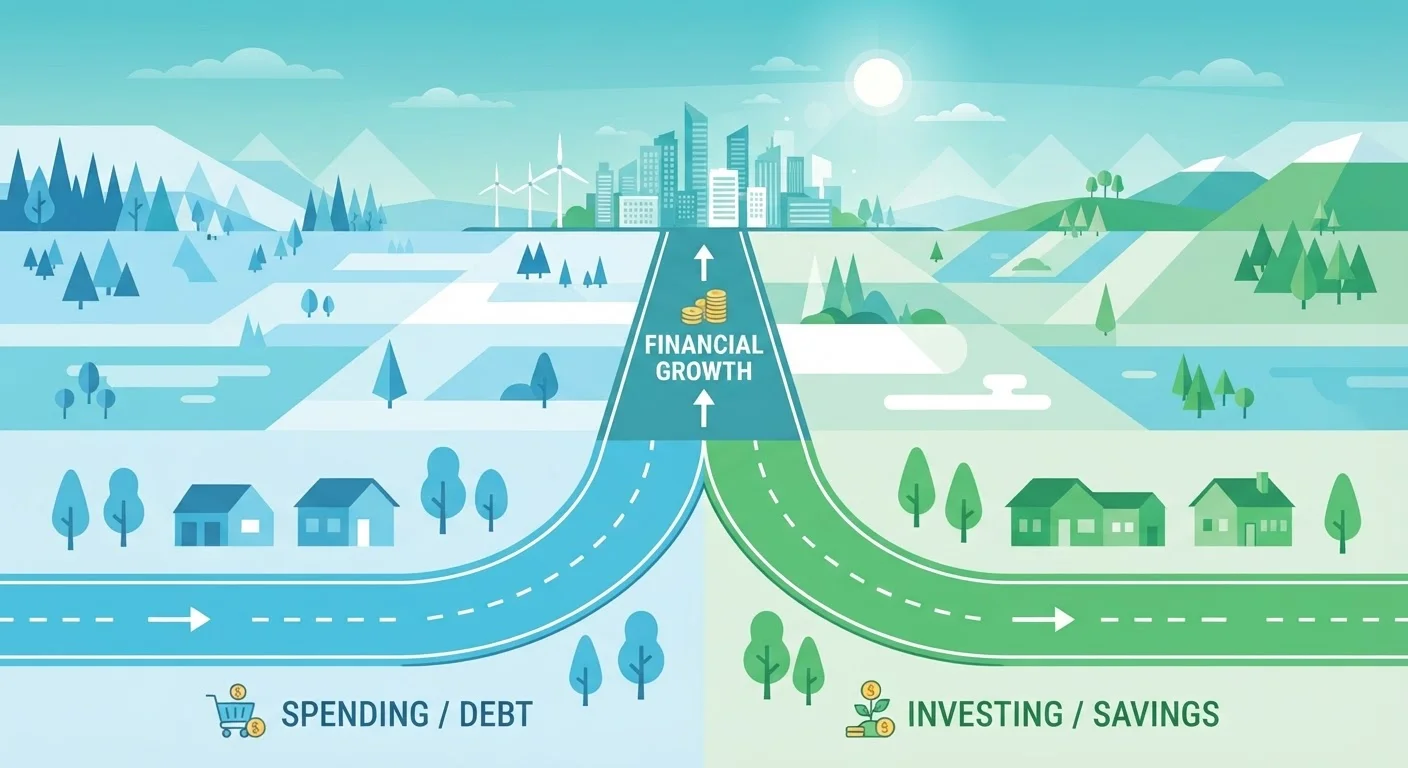
Most personal finance advice oversimplifies this question. The reality is that saving and paying off debt are not opposites — they are two levers on the same machine. Pulling one harder affects the other, and the right balance shifts depending on your interest rates, income stability, employer benefits, and psychological relationship with money.
The core tension is mathematical: every dollar sitting in a savings account earning 4–5% while you carry a credit card balance at 20–25% is effectively losing ground. But every month without an emergency fund raises the risk that an unexpected expense sends you deeper into debt. Understanding this tension — rather than resolving it with a simple rule — is the starting point for a genuinely useful decision. This article is for general educational purposes; for guidance tailored to your situation, consider speaking with a licensed financial adviser.
See our complete guide to saving and managing debt together for a broader framework on building lasting financial stability.
The Case for Paying Off Debt First
When debt carries a high interest rate, paying it down delivers a guaranteed, risk-free return equal to that rate. Eliminating a 22% APR credit card balance is the financial equivalent of earning 22% on an investment — something no savings account or low-risk investment reliably offers.
| Prioritize Debt Payoff | Prioritize Saving | Hybrid Approach | |
|---|---|---|---|
| Best suited for | High-interest debt holders | Low-rate debt, stable income | Most common situations |
| Interest cost impact | Reduces interest quickly | Interest continues accruing | Balanced reduction over time |
| Emergency preparedness | Low if no buffer kept | High with growing fund | Moderate buffer maintained |
| Retirement match captured | May be missed | Yes, if prioritized | Yes, built into plan |
| Psychological benefit | High — debt disappears faster | Moderate — savings grow visibly | Balanced — progress on both fronts |
| Risk if income disrupted | Higher — no liquid cushion | Lower — savings available | Moderate — small buffer exists |
High-interest consumer debt — typically credit cards, payday loans, and some personal loans — is where this argument is strongest. The math is hard to argue with: paying only the minimum on credit cards can extend repayment by years and dramatically inflate total interest paid. If your debt falls into this high-rate category, directing maximum available cash toward it while maintaining only a minimal savings buffer is often the most cost-efficient approach.
There are also psychological benefits. Research in behavioral finance consistently shows that eliminating debts — especially visible, stressful ones — reduces financial anxiety and frees cognitive bandwidth for other goals. If you are weighing different payoff strategies, the debt avalanche vs. debt snowball comparison explains both methods in detail.
The Case for Saving First (or Saving Simultaneously)
Saving before — or alongside — debt repayment is not irresponsible. In several situations, it is clearly the smarter move.
- Emergency fund priority: Without at least a small liquid buffer, any unexpected expense (car repair, medical bill, job disruption) forces you back to credit. Most financial planners suggest a starter emergency fund of roughly $1,000 before aggressively paying debt, with the goal of eventually building 3–6 months of expenses.
- Employer 401(k) match: If your employer matches retirement contributions, not contributing enough to capture that match is forfeiting compensation. A 50% match on contributions up to 6% of salary is a 50% return on that portion of money — nearly always higher than even high-interest debt rates.
- Low-interest debt: Federal student loans, mortgages, and some auto loans often carry rates well below what a disciplined investor might reasonably expect from a diversified portfolio over time. Prepaying these aggressively while keeping savings low may not be optimal, though this involves market risk and is not guaranteed.
Start With a $1,000 Starter Fund
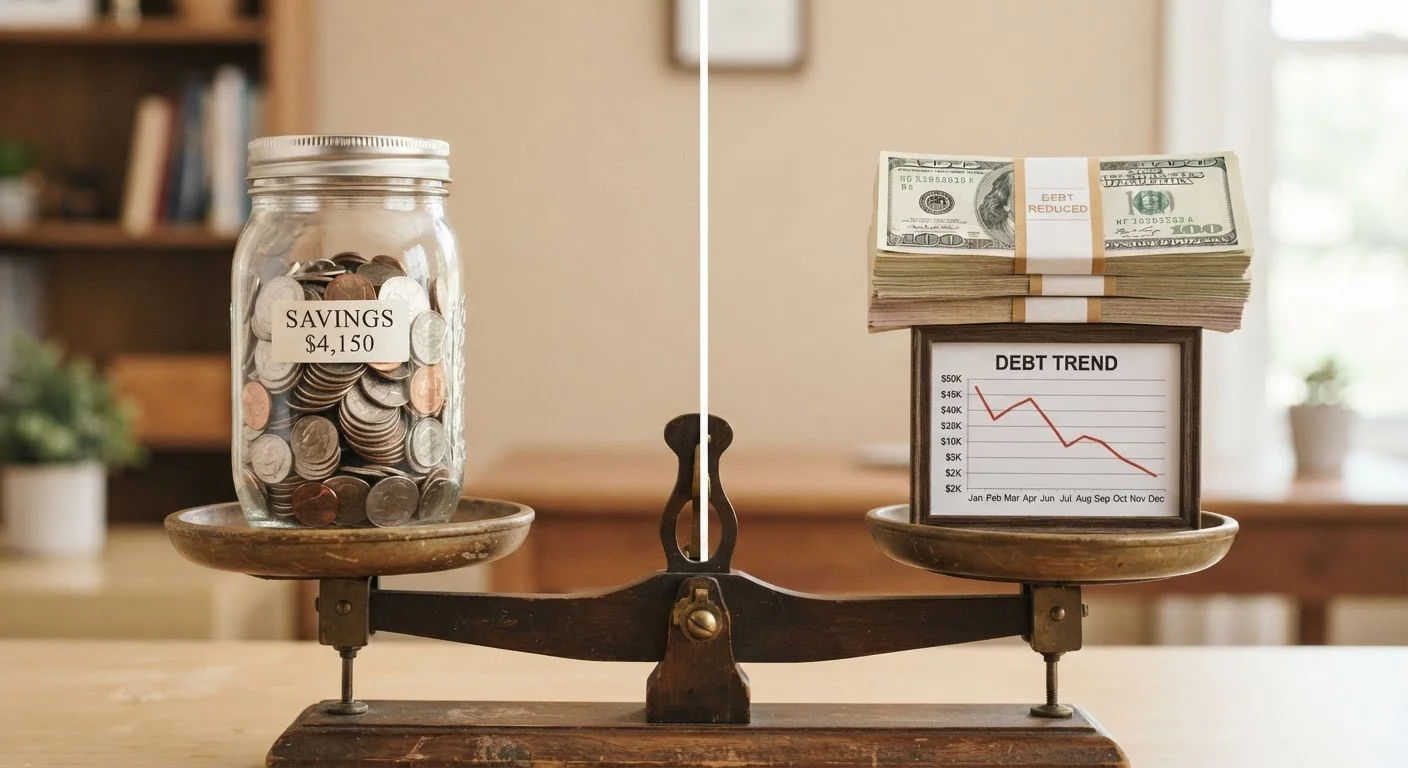
Before aggressively attacking debt, consider building a modest emergency reserve of around $1,000. This small buffer prevents a single unexpected expense from derailing your payoff plan by forcing you back to credit. Once high-interest debt is eliminated, you can expand this fund to cover 3–6 months of essential expenses.
For those newer to saving, our article on building a savings habit from zero offers a practical entry point.
A Decision Framework: Key Variables to Weigh
Rather than a single rule, consider these four variables when determining your personal balance:
- Interest rate of your debt: Above roughly 7–8%? Prioritize payoff. Below that? Saving and investing alongside minimum payments is more defensible.
- Income stability: Variable or uncertain income raises the value of a liquid emergency fund. Stable salaried employment makes aggressive debt payoff less risky.
- Available employer benefits: Capture any employer retirement match before directing extra dollars to debt — it is one of the clearest wins in personal finance.
- Psychological factors: Some people genuinely need visible debt elimination to stay motivated. Others need to see a savings balance grow. Your personal savings rate can serve as a useful progress metric regardless of which path you choose.
Automation can also make a hybrid approach sustainable. Scheduled transfers for both savings and loan payments remove the need for repeated willpower-based decisions each month.
~$6,500
Average American credit card balance
According to Federal Reserve consumer credit data, average revolving credit balances per borrower have remained in this range in recent years.
20%+
Typical credit card APR
The Federal Reserve's consumer credit report tracks average credit card interest rates, which have exceeded 20% APR in recent periods.
~40%
Adults lacking $400 emergency savings
Federal Reserve surveys have consistently found that a substantial share of U.S. adults would struggle to cover an unexpected $400 expense without borrowing.
When Debt Feels Overwhelming: Warning Signs to Watch
Sometimes the debate between saving and paying debt is secondary to a more urgent question: has your debt load become unmanageable? Relying on credit cards for basic living expenses, missing minimum payments, or watching balances grow despite regular payments are signals worth taking seriously. Our article on signs your debt load may be reaching a tipping point covers the warning indicators to monitor.
If you are considering restructuring, debt consolidation is one option worth understanding clearly — including its limitations — before acting. Similarly, personal loans used to pay off debt come with tradeoffs that deserve careful scrutiny.
Once you have stabilized your debt situation and built a foundation of savings, the next step for many people is thinking about longer-term wealth building. Foundational investing concepts can help you understand what comes next — and why delaying investing even briefly can have meaningful long-term consequences.
This article is intended for general informational and educational purposes only and does not constitute personalized financial, investment, tax, or legal advice. Consult a qualified financial professional before making decisions based on your individual circumstances.